Backpacking trip: Choosing your gear!
Our complete gear checklist for a long-term backpacking trip. Field-tested, with our real choices, tips, and feedback from experience.
Backpacking trip: Choosing your gear!
3 rules for choosing the right backpacking travel gear
Good gear isn't about taking everything. It's about taking what really serves you, for a long time, and in several situations. Let's not kid ourselves: when you have a good wardrobe, making choices is painful. But we set ourselves 3 simple rules, and they changed everything:
Versatility over quantity. A pair of pants that works in the city AND on the trail, a T-shirt that dries quickly and works anywhere, each piece should tick several boxes. If a garment only serves in one context, it doesn't make it into the pack.
Comfort before aesthetics. We know, it's hard to hear. But after 8 hours on a bus with a bag on your lap, you'll be glad you chose comfort. Aesthetics is a bonus, not a priority.
Tested before leaving, not on site. Every piece of gear should be tried, worn, folded, and rolled BEFORE departure. Discovering that your tent leaks or that your pack hurts your back at 4,000 meters altitude is the kind of surprise we can do without.
Choosing the right backpack
Packing your bag and gear is THE big step that makes a trip feel real. But let me warn you right away: no departure is perfect. Yes, you will forget things, and that’s okay. You’ll forget because you already had a thousand things on your mind, or because you didn’t yet know you were going to need them.
Your backpack will hold all your belongings, follow you everywhere, and be on your back regularly. This is not a choice to take lightly. Whether it’s new or second-hand, here are the 5 essential criteria.
01. Adjustable to your body shape
A good backpack is one that’s adjusted for your back. The hip belt should rest on your hips, and the shoulder straps should fit your shoulders without pulling. Always try it on in the store with weight inside.
02. A comfortable frame
The frame (or lack of one) changes everything on long hikes. Tristan prefers soft packs without metal bars; it’s up to you to test what suits you best.
03. A capacity suited to your trip
For a trip of more than 15 days, we recommend a backpack with a minimum capacity of 55 liters. Adjustable models like 55L + 10L are perfect: they adapt to the duration and type of trip.
04. Enough compartments
Being able to reach your toiletry bag without emptying the whole backpack is priceless. Side pockets, bottom compartments, front openings—all of that matters.
05. Strong materials
Your backpack is going to be dragged through bus cargo holds, left in the dust, and soaked in the rain. Invest in a sturdy backpack; it’s one of the few pieces of gear you shouldn’t buy on the cheap.
Plan B If your budget is tight, look at second-hand options. Sites like Leboncoin, Vinted, or in-store gear resale events (Décathlon offers a second-life program) can help you find quality backpacks at low prices. The important thing is that it’s in good condition and suited to your body shape. |
Our 2 bags
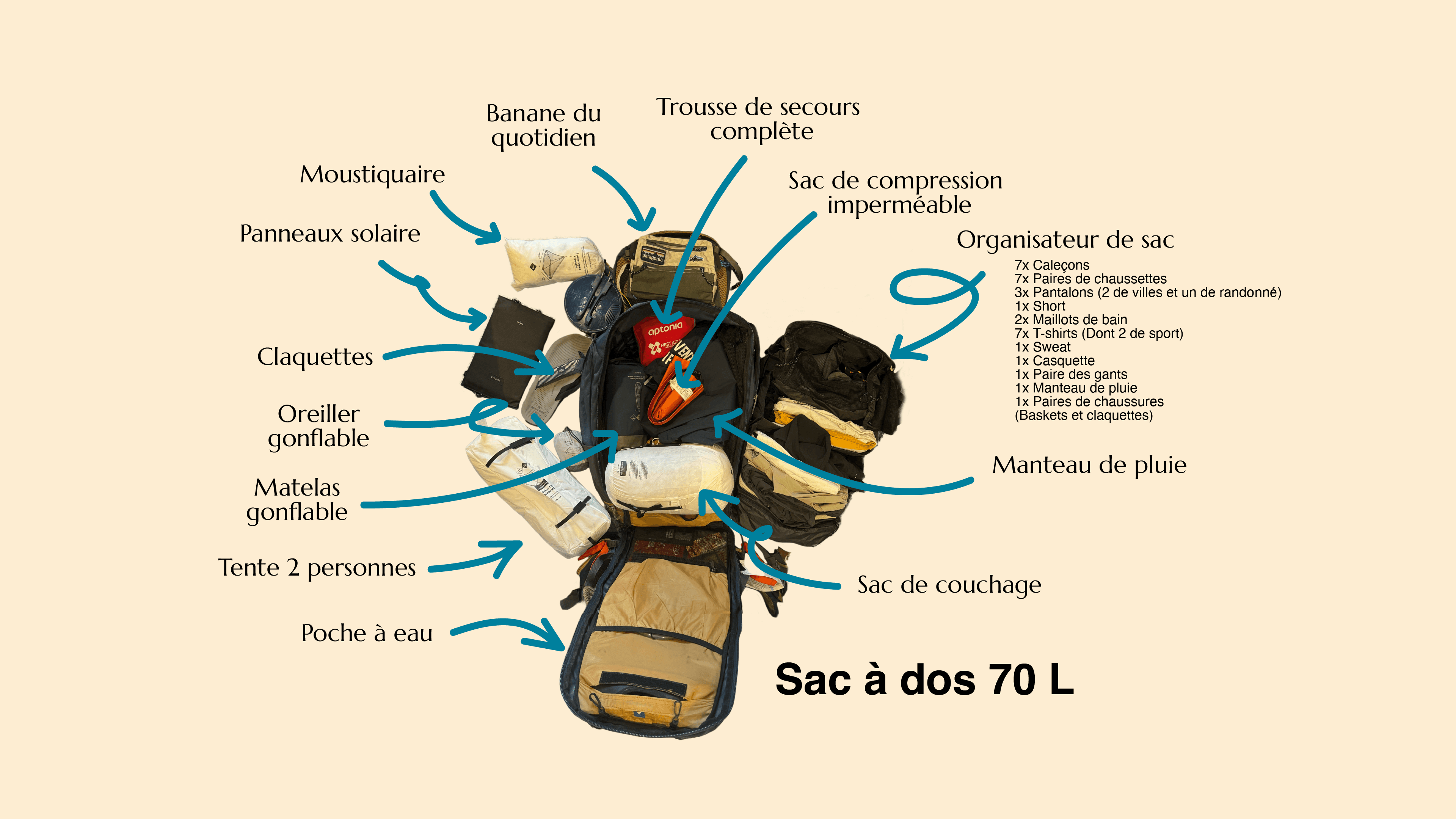
Tristan's Pack
Main pack: Quechua Escape 70L
This particular model is no longer on the market, but you can find similar options at Decathlon in their Forclaz Travel 900 range. I chose this pack for its generous capacity and because I kept seeing it on long-term travelers. My favorite feature: it's soft with no rigid metal frame, making it super easy to compress and squeeze into packed bus luggage compartments.
Mathilde's Pack
Main pack: Forclaz Travel 900 Easy Fit 60L+6L
I went with this model because it's specially designed for a woman's build. The suitcase-style opening is a total lifesaver—no more unpacking your entire life just to grab a t-shirt from the bottom of the bag. I also use packing cubes to keep my clothes categorized, and honestly, it makes daily life on the road so much smoother.
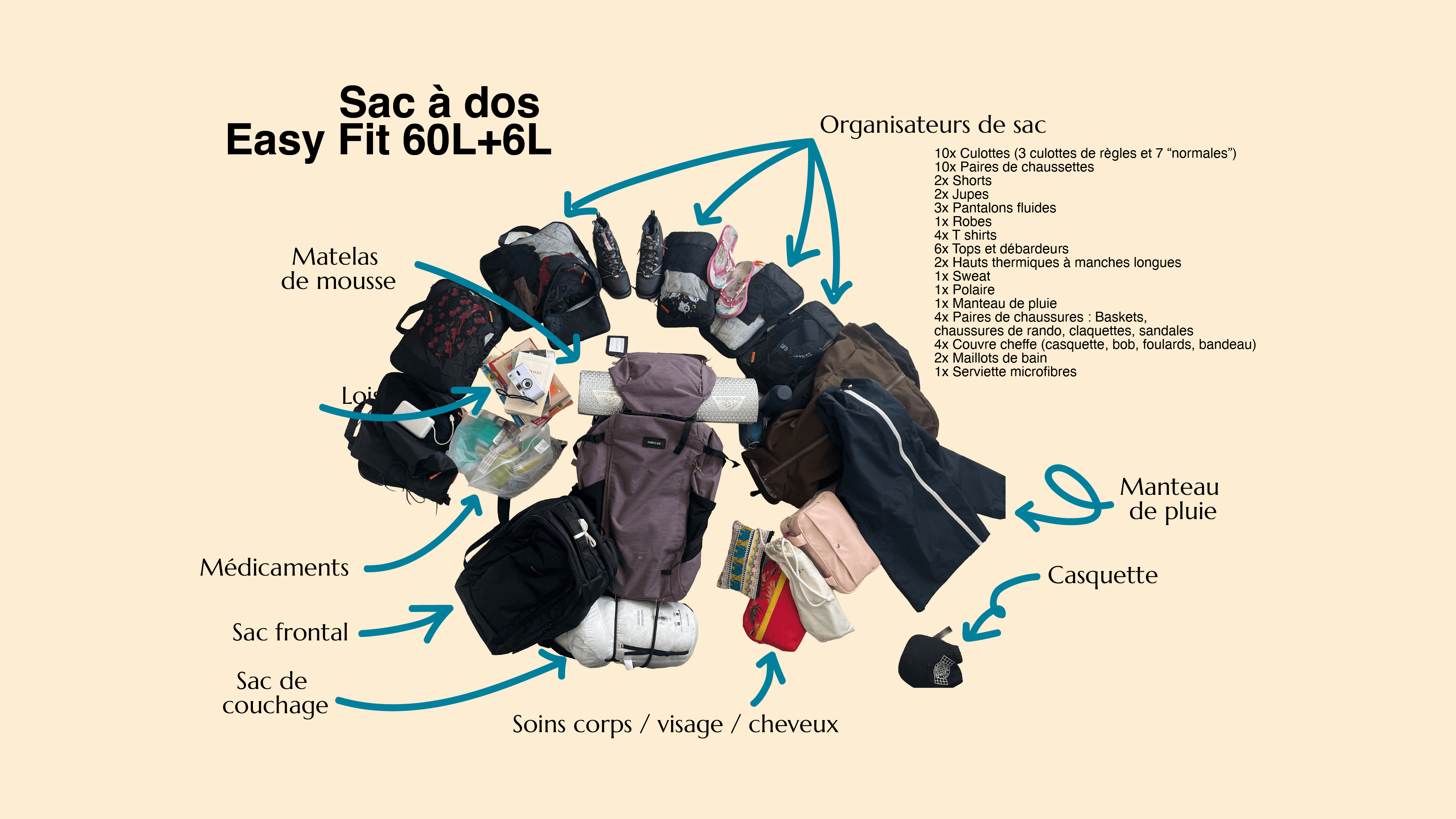
Pro Tip from the Trail - Mathilde Packing cubes are an absolute game changer for backpacking. One cube for tops, one for bottoms, and one for underwear. You can find everything in a heartbeat, and your pack stays neat and organized even after 3 months on the road. It's a tiny investment that makes a massive difference in daily comfort. |
Tips for Choosing the Right Travel Clothes
Choosing clothing is essential for adapting to temperature changes, and believe us, on a round-the-world trip, you can easily go from the desert to the mountains in just a few days. Here are our principles.
Think in layers, not in thickness. Several thin layers (technical T-shirt + lightweight fleece + windbreaker) are better than one big puffer jacket. You can adjust according to the temperature, and each item takes up less space in the bag.
Prioritize versatility. Zip-off pants that turn into shorts, T-shirts that work in the city as well as on hikes, shoes that are good for trekking and walking around town, each item should tick at least two boxes.
Pack more underwear than tops. Underwear gets changed every day; a T-shirt can last 2-3 days (especially merino). Recommended ratio: 7 to 10 pairs of underwear for 4-5 tops.
Choose materials that dry quickly. Cotton is comfortable, but it takes forever to dry. Synthetic fabrics or merino wool dry in a few hours, which is crucial when you're hand-washing in the hostel sink.
Plan B Forgot something? No panic. In most countries, you'll find markets and shops with basic gear at low prices. We bought socks, shorts, and a towel along the way, and sometimes at a better price than in France. The important thing is not to forget anything vital (passport, specific medication, prescription glasses). The rest can be found. |