
Traveling without a return ticket: the complete guide to making it legal
Planning a trip around the world, a long-term adventure, or just a one-way ticket to a faraway destination? From refundable tickets and onward tickets to overland travel options, here are all the best ways to set off on a one-way journey without getting stuck at the airport.
Traveling without a return ticket: the complete guide to making it legal
Why return tickets can be a headache for travelers

When we talk about a return ticket, we should really be talking about an onward ticket. The idea is simple: the country you are arriving in wants proof that you will actually leave before your authorized stay ends. This ticket must prove you are exiting the country; it is an official entry requirement in many countries around the world.
For a typical holidaymaker heading off for a two-week vacation with a round-trip ticket, this is never an issue. The problem arises for those travelling on a one-way ticket: round-the-world backpackers, travellers who don't yet know when they'll leave, those planning to cross the border by land (bus, train), or simply anyone who prefers to keep their itinerary flexible. When you're on the road for several months, buying a dummy return ticket for every single country you cross is both expensive and a real hassle.
Who actually asks to see an onward ticket, and why?
Border Control on Arrival
When you arrive in the country, the border police officers might ask for proof of onward travel during passport control. In practice, they rarely ask for this. Many travelers cross dozens of borders without ever being asked. But "rarely" doesn't mean "never," and all it takes is one overzealous officer to land you in a tricky situation.
If the border officer decides you don't meet the entry requirements, the consequences can be tough: deportation on the next available flight (at your expense or the airline's), or being forced to buy an onward ticket right there on the spot. In the best-case scenario, a polite conversation explaining your travel plans can save the day.
Airlines at Check-in
In reality, this is where you'll face the test most often. Airlines know that if you are denied entry at your destination, they are legally required to fly you back at their expense. To protect themselves, they often check that you have an onward ticket from your destination country before letting you board. If you don't, they can quite simply refused to let you board the plane. This is the most common and easily the most frustrating scenario, as it stops your trip before it even begins.
Why Does This Rule Exist?
The goal is simple: to prevent illegal immigration. The host country wants to make sure you won't overstay your maximum allowed stay and settle down illegally. It's a migration control method used by most countries outside the European Union. As for the airlines, they are simply trying to avoid expensive repatriation costs, which can easily run into thousands of euros.
Destinations where you can expect regular checks
The list of countries that officially require proof of onward travel is long. To check a country's exact requirements, the two most reliable sources are the France Diplomatie website (Ministry for Europe and Foreign Affairs) and the IATA Travel Centre (the International Air Transport Association, which represents over 260 airlines). Here is a quick breakdown by region where you are most likely to have your ticket checked.

Checks are random, but some countries are known to enforce them much more strictly than others. Here is a quick breakdown by region, based on official details from France Diplomatie and the IATA Travel Centre.
The Americas: The strictest region in the world
Country | Risk Level | Notes |
|---|---|---|
États-Unis | ⚠️ High | Your onward ticket must not head to Canada, Mexico, or the Caribbean |
Canada | ⚠️ High | Frequent checks at check-in |
Mexique | ⚠️ High | Regular checks, especially on flights coming from Europe |
Brazil | ⚠️ Medium | Checks vary depending on the airport |
Argentina | ⚠️ Medium | Frequent checks at check-in |
Chili | ⚠️ Medium | |
Colombie | ⚠️ Medium | |
Peru | ✅ Low | Overland travel tickets are officially accepted |
Costa Rica | ⚠️ High | |
Panama | ✅ Low | Overland travel tickets are officially accepted |
Southeast Asia: One to watch
Country | Risk Level | Notes |
|---|---|---|
Thaïlande | ⚠️ High | Very frequent checks, especially in Bangkok |
Philippines | ⚠️ High | |
Indonésie | ⚠️ Medium | |
Malaisie | ⚠️ Medium | |
Vietnam | ⚠️ Medium | |
Singapour | ⚠️ High | |
Japon | ⚠️ Medium | |
Cambodge | ✅ Low | Generally relaxed |
Laos | ✅ Low | Generally relaxed |
Oceania
Country | Risk Level | Notes |
|---|---|---|
Australie | ⚠️ High | Checks are almost systematic |
Nouvelle-Zélande | ⚠️ High | Checks are almost systematic |
Africa
Country | Risk Level | Notes |
|---|---|---|
Afrique du Sud | ⚠️ Medium | |
Kenya | ⚠️ Medium | |
Tanzanie | ⚠️ Medium |
Europe
Good news: within the European Union and the Schengen Area, return tickets are not required for European citizens. The United Kingdom (post-Brexit) can technically ask non-residents for one. Russia does require an onward ticket.
Taking it further: To verify the exact requirements for a specific destination, check the country page directly on France Diplomatie or the IATA Travel Centre. These are the two most reliable official sources out there.
Beat them to the punch and save yourself having to explain
Checks are random. The best strategy is to make sure you're never asked that dreaded question. Here are the dos and don'ts to keep in mind.
At border control: what to avoid
Never make jokes with a border officer. Humor doesn't fly at checkpoints.
Don't say you "aren't really sure" or that you'll "just see how it goes" for the rest of your trip.
Always have a credible plan to present, even if it's a bit vague.Never mention that you are considering working locally, even as a freelancer.
Avoid being among the last in line at the counter: officers at the end of their shift are often more meticulous.
Never say you don't have much money. A traveler who seems unable to fund their stay raises suspicions.
If your passport contains visas from countries with a "bad reputation", be ready to explain your itinerary calmly.
Use your French privilege. Much of the world has no issue with French tourists, and extra checks are rare. The only countries where we felt a difference were Thailand and Mexico.
At airline check-in
The agent at the counter isn't there to interrogate you. Their job is to check your documents and let you board. The goal is to fly under the radar to avoid that dreaded question. Present your documents with confidence, be polite, don't volunteer extra information, and everything should go smoothly. Busy times work in your favor: when there is a long queue, checks are naturally less thorough.
What should you do if you're asked to show a return ticket?
At the airline check-in desk
First option: calmly state that you do have a return ticket. If you are asked to show it, say that you have it in electronic format but haven't printed it out. If the agent insists, keep your cool (never forget this rule). Never get angry: it never works and always makes things worse. Be patient, friendly, and use your best charm.
If all else fails, you still have time to use one of the practical solutions in the next section, provided you arrived early enough at the airport. You will need a smartphone with an internet connection (airport WiFi works just fine).
Facing immigration on arrival
Unlike at check-in, whatever you do, don't lie to an immigration officer. They are professionals trained to spot lies and anxiety from a mile away. Just explain calmly that you don't have a return ticket because you plan to leave the country by land (bus or train) to such-and-such country, around such-and-such date. Show them your previous visas to prove that you've always respected stay limits. If you have any onward flight tickets for the rest of your trip (even from another country), show them those. As a last resort, offer to buy an onward ticket right then and there. Most officers will agree to this rather than starting a deportation process.

Practical ways to travel without a return ticket
Several strategies exist to get around this issue without breaking the bank. Some are free, others cost just a few euros. Here are the main options, ranked from the most reliable to the riskiest.
Check if a round-trip ticket is cheaper than a one-way
It might seem counter-intuitive, but it's a reality of the airline market: a round-trip ticket often costs less than a simple one-way. Airlines use this pricing to encourage round-trip travel. Before buying a one-way ticket, always compare the prices. If the round-trip is the same price or cheaper, book it: you solve your return ticket issue and potentially save some cash. You're under no obligation to actually use the return flight.
Buy a cancellable and refundable plane ticket
This is the most legally solid solution. You buy a real onward ticket, use it as proof, and then cancel it after entering the country. The secret is finding fully refundable tickets with no fees.
Several ways to do this: Business class tickets are sometimes refundable with no cancellation fees if you respect the window indicated in the terms. More accessibly, certain platforms like Orbitz allow you to get a full refund if the ticket is cancelled within 24 hours of purchase, depending on the airline selected (avoid Ryanair, Frontier, and AirAsia, which handle cancellations themselves).
For Asia, Cathay Pacific offers an interesting option: by joining their loyalty program (Green Member) for free, you can buy a flight with your member number and cancel it for a full refund within 24 hours, provided the flight is scheduled at least 8 days after purchase. Copa Airlines offers a similar system for travel in the Americas. Just be careful with your timing: if your flight is 15 hours long and you estimate 3 hours to clear the airport and find an internet connection, buy your return ticket at least 18 hours before your departure to give yourself time to cancel when you land.
Onward ticket by land
A bus or train ticket is significantly cheaper than a plane ticket. Good news: in many countries, an onward ticket by land is officially accepted as proof of continuation. This is notably the case for Russia, Peru, and Panama (information verified with the embassies). On the other hand, the United States does not accept this option.
The catch: airline check-in agents rarely know this nuance and can make things difficult. If you choose this option, be ready to make your case. The best approach is to contact the embassy of your destination country directly to get a written confirmation that land tickets are accepted. This will give you a solid argument to present at the boarding gate.
Hotel reservation in a neighboring country
If you have a confirmed hotel reservation in a neighboring country, that can be enough to convince a customs officer that you plan to leave the territory. However, this solution is virtually useless at airline check-in, where they will demand a transport ticket, not accommodation. Use this as a supporting argument or a backup plan, not your main strategy.
Plane ticket from a neighboring country
You don't have an onward ticket departing from Country X, but you have a booked flight leaving from neighboring Country Y. This is an argument that can convince a customs officer if your story is consistent and your passport shows a credible itinerary. For round-the-world travelers with multi-destination tickets, this is often the argument that saves the day. At check-in, however, it's rarely enough because agents follow strict procedures and don't want to take any risks.
Onewayfly and Onward Ticket: we demystify this popular solution
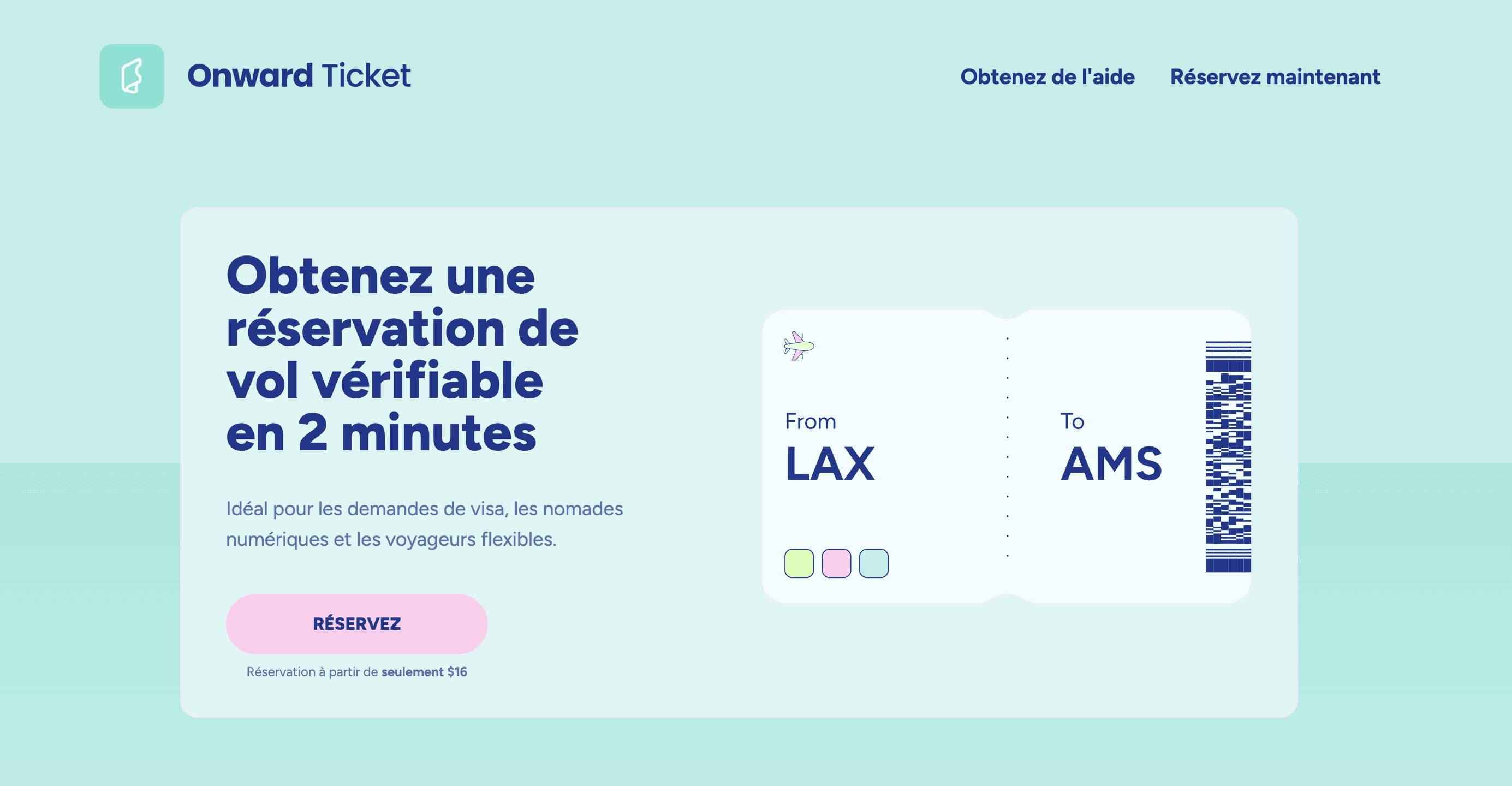
Several websites have specialized in this issue and offer a quick, budget-friendly solution. The two best-known are Onewayfly and Bestonwardticket. They work the exact same way, and it's well worth understanding how they operate before you use them.
How it works
For about 12 à 20 euros, these services set up an official booking in your name. Just to be clear: this isn't an actual e-ticket, but a genuine fight reservation with an airline, complete with a verifiable PNR number (Passenger Name Record). When you look it up on the airline's website, it looks just like the real deal. It has all your travel details: passenger name, dates, itinerary, and flight number.
This reservation stays active for a limited time: 48 heures with Best Award Ticket, and up to 2 semaines with Oneway Fly. Once that window closes, it gets canceled automatically. The trick is to use it as your proof of onward travel at check-in and border control, and then just let it lapse naturally.
Does it really work?
We have used it several times and security has always let us through. On top of that, feedback from other travelers is overwhelmingly positive. On travel forums and Trustpilot reviews, about 97 to 98% of users have had absolutely no issues. The destinations with the most favorable feedback include Thaïlande, Argentina, Colombie, Philippines, Vietnam, and the USA. The rare reported hiccups usually involve destinations like China or Greece, where checks tend to be a bit more meticulous.
The main risk is a particularly scrupulous check-in agent who might notice that the booking hasn't been paid for yet (missing a 13-digit number confirming actual payment of the ticket). In practice, this verification is extremely rare at check-in. It is slightly more likely with border control officers, which is why it is best not to try this technique in countries known for being very strict.
Step-by-step guide on how to use it
Choose the departure country for your onward ticket (the country you are traveling to).
Select an onward destination: a country that does not require a visa in advance, or even France.
Enter a coherent departure date: not the day after you arrive, and well within the allowed duration of your stay.
Schedule the ticket delivery for the day of your departure, so that it is still active when you arrive.
Once you receive it, use the PNR code on the airline's website to generate a page that looks like a real e-ticket. This is much more convincing than the raw email sent by the booking service.
Our take
It is a practical, fast, and budget-friendly solution that works in the vast majority of cases. However, it is not foolproof. We recommend keeping this trick for countries with moderate controls, and opting for a refundable ticket for destinations known for being very strict (USA, Australia, New Zealand). Always arrive early at the airport to give yourself enough time to buy a real ticket just in case.
Fake tickets: why it is a bad idea
We need to talk about this because it is a question many travelers ask and competitors often bring up, so let's be clear. It is technically possible to forge a fake plane ticket by editing a PDF. Traveler testimonials show that this has sometimes worked at check-in.
We absolutely do not recommend it, and here is why:
It is fraud, with potentially serious legal consequences
Flight details can be verified instantly using tools like CheckMyTrip: it only takes two seconds to see that an invented booking reference does not exist
When facing a customs officer, getting caught with a fake document can lead to a long-term entry ban to the country, or even prosecution
Services like Onewayfly cost 12 to 20 euros and are completely legal, so there is no reason to take that risk
Conclusion
Traveling without a return ticket is not illegal. It is a perfectly normal practice for long-term travelers, world-tourists, and digital nomads. The real challenge is knowing how to handle the random checks that can happen at the airport, both at check-in and at border control. With the right strategies in mind (refundable ticket, temporary booking, overland ticket) and a little bit of preparation, you can head off peacefully with a simple one-way ticket without ever getting stuck.
The key is to never set off without at least a backup plan in mind. Whether it is a refundable ticket bought the day before, a Oneway Fly booking in your inbox, or simply knowing the rules of the country you are visiting, this five-minute prep can save you hours of stress, hundreds of euros in unexpected expenses, and, in the worst-case scenario, being sent right back to your home country. Safe travels and happy adventures, return ticket or not.