Free Walking Tour in Cusco
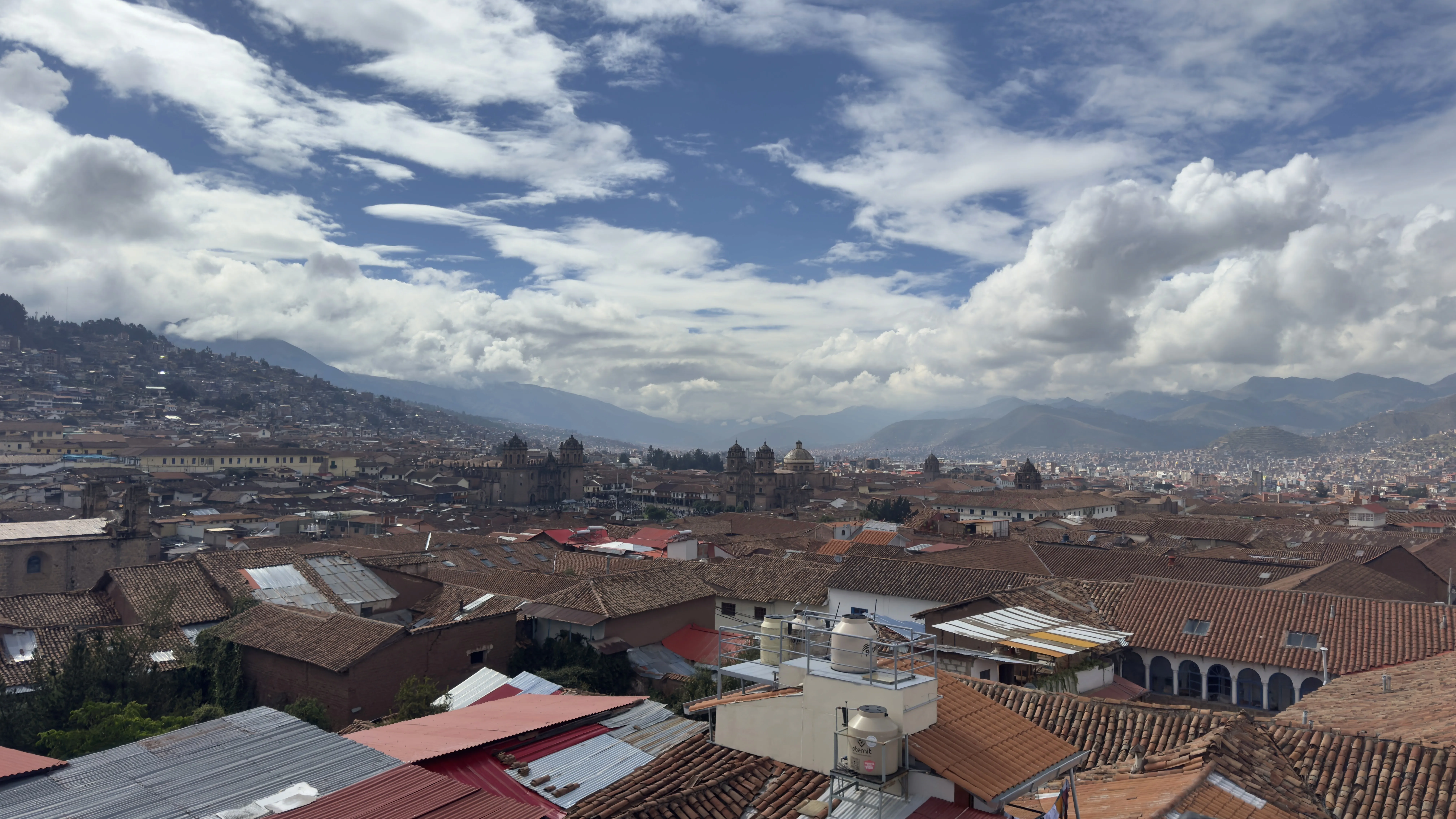
A free walking tour of Cusco packed with history. Discover the best of Cusco simply by wandering through its streets.
Free Walking Tour in Cusco
Exploring Cusco on foot, history at every turn
When we first arrived at Plaza de Armas, feeling a little short of breath and lightheaded (welcome to 11,150 feet/3,400 meters!), we figured a free walking tour would be the perfect way to get our bearings before exploring on our own. We managed to dive into 3,000 years of history in just a 3-hour walk.
What we quickly realized is that Cusco isn't just a city with ruins. It’s a city built directly ON centuries-old foundations, which themselves were built on even older ones. Three civilizations stacked together like a stone mille-feuille. Once you grasp that, you'll never look at another Cusco wall the same way again.
Here is the route we followed, the stories we heard, and what really stood out to us. If you're heading to Cusco, this walking tour is the absolute best way to spend your first morning.
Practical info Free walking tours depart daily at 10 AM, 1 PM, or 3 PM from Plaza de Armas (just look for the guides holding colorful umbrellas). Duration: 2.5 to 3 hours. It's free, but tips are expected (S/20-40 is a good standard). Pack some water, sunscreen, and a fleece — at this altitude, the sun burns hot, but the wind bites. |
Stop 1: Plaza de Armas, the meeting point
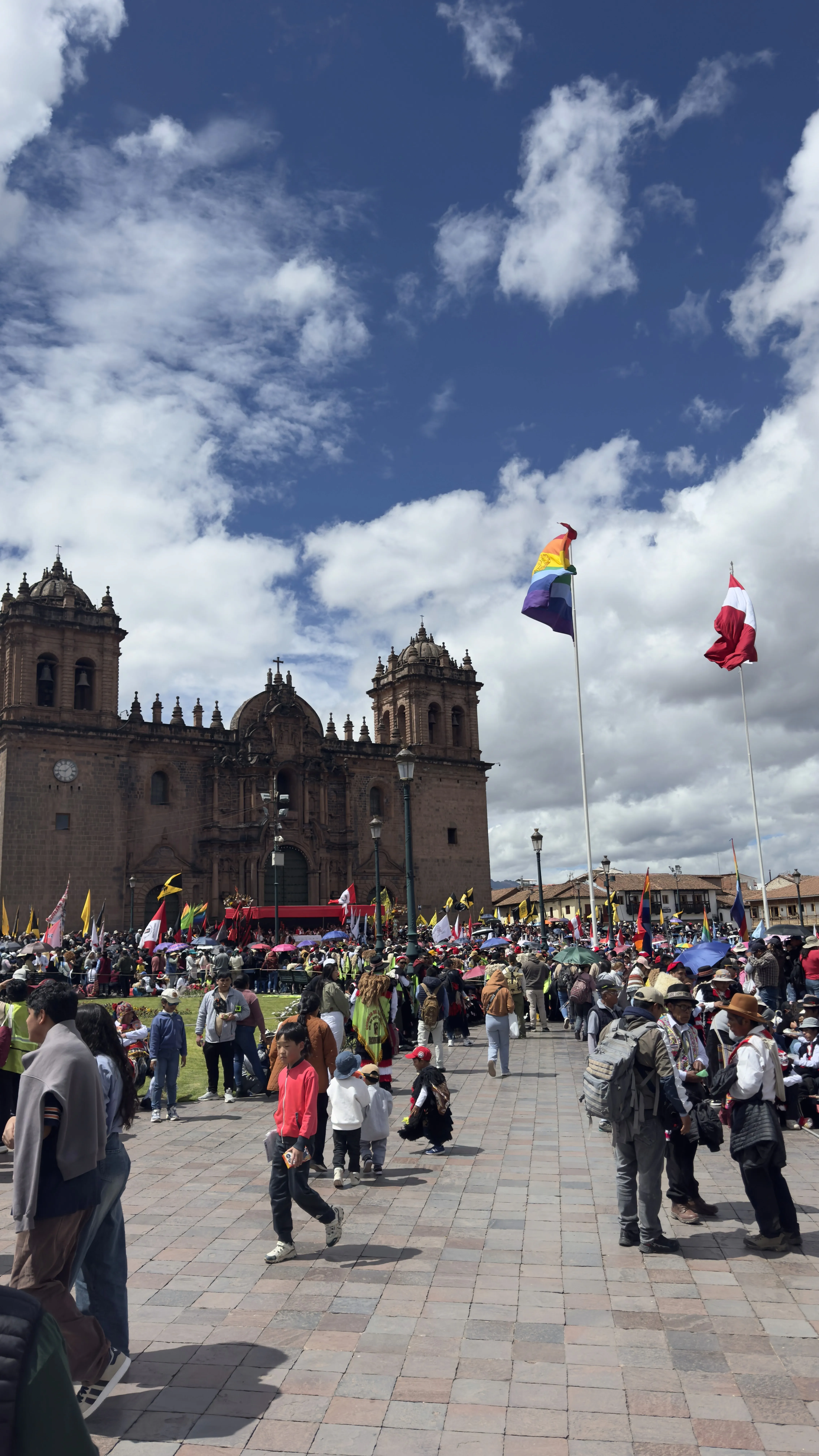
Everything starts right here, at the Plaza de Armas. This is the meeting point for the free walking tours—just look out for the guides with their colorful umbrellas and the small groups gathering around.
Before you even take your first step, your guide will set the scene. When you first arrive in Cusco, one of the first things you'll notice are the multicolored flags flying everywhere. A rainbow pride flag? Not quite! It's actually the official flag of the city of Cusco. This flag features the colors of the Tawantinsuyu (the Inca Empire) and represents its four regions. It was adopted in 1978 by the municipality of Cusco as a proud symbol of regional identity.
Fun little fact: the Cusqueño flag was actually created 11 years before the LGBT rainbow flag (1989). The two are completely unrelated, but tourists mix them up all the time. Local Cusqueños are half-proud, half-resigned about it.
Our guide also reminds us that Cusco isn't a museum: it's a bustling city of 600,000 people, growing fast. Modern neighborhoods spread out around the historic center, markets are bursting at the seams, and students from San Antonio Abad University blend in with tourists on the Plaza.
The guide kicks things off with a question: "See this beautiful square? Now, picture it twice as big."
That's because today's Plaza de Armas is only half of the original Huacaypata, the Inca ceremonial square that served as the absolute center of the Empire. The Spanish cut it down in size, destroyed the surrounding Inca palaces, and built their churches and colonial mansions right on top. But—and this is where it gets fascinating—they kept the Inca foundations.
Why? Because the Inca stones were too well-carved, too massive, and too perfectly fitted to be destroyed. So, the colonizers just worked with them. As a result, even today, every building around the square rests on Inca walls. At the bottom, you see the surgical precision of the Incas. At the top, Spanish Baroque. You'll spot this contrast everywhere.
The Shadow of Pachakútec
And that figure standing proud right in the center is Pachakútec, the 9th Inca emperor, the man who changed everything. Before him, the Incas were just one mountain tribe among many. After him, they ruled a 4,000 km-long empire. He's the one who turned Cusco into an imperial capital, built the Coricancha (Temple of the Sun), and kicked off the construction of Sacsayhuáman. In Quechua, his name means "He who transforms the world," and he certainly lived up to it.
His golden statue overlooks the Plaza, arm raised, looking out toward the mountains. The guide explains that Pachakútec didn't just expand the borders—he reorganized the Empire into 4 regions (the Tawantinsuyu), set up a network of roads and public granaries, and established an incredibly efficient administration. All of this without a writing system. Instead, the Incas used quipus—knotted strings—to keep track of absolutely everything.
The Inca Hierarchy: A Well-Oiled Pyramid
The guide pulls out a pyramid diagram to show us the social structure of the Empire. At the very top was the Inca, the emperor, son of the Sun. Just below came the Realeza (the royal family): the Auqui (the crown prince) and the Panacas Reales, the descendants of each previous emperor. Then came the Nobleza—the nobility of blood (distant relatives) and nobility of privilege (meritorious officials). Finally, there was the Pueblo, the common people, organized into ayllus (communities), who worked the land and built the roads.
What really stands out is that it was a redistributive system: taxes were paid in labor (the mita), and in return, the state provided food, clothing, and security. No money, no markets. Everything was centralized and shared back out. It was a grid that fed 10 million people without a single person going hungry—at least according to the chroniclers of the time.
Stop 2: Cathédrale Notre-Dame-de-l'Assomption
Don't leave the Plaza just yet. Cusco Cathedral is a baroque masterpiece. But when your guide tells you to look closer at the paintings, you'll see they actually tell a story of silent rebellion.
After the conquest, the Spanish tried to enforce Catholicism. They commissioned hundreds of religious paintings. The catch (for the colonizers) was that the painters were local indigenous artists. And these artists managed to slip their own sacred symbols into the biblical scenes.
Look at the Cusco paintings like a treasure hunt: every hidden Andean symbol in a biblical scene is a secret message from the artists to their fellow people. |

The Virgin Mary wears a triangular robe that calls to mind the Cerro Rico of Potosí (the silver mountain, a symbol of Pachamama). The cathedral's most famous Last Supper shows Jesus and his disciples gathered around... a roasted guinea pig (cuy) and glasses of chicha. Local fruits take the place of European bread and wine, and Inca suns shine in the halos of the saints.
This is what’s known as the Cusco School of Painting, an artistic movement born from the (forced) meeting of two cultures. Indigenous painters followed Catholic requests while keeping their own identity alive. Every painting is an act of resistance disguised as devotion.
Stop 4: Calle Loreto, the Inca walls, and the House of the Chosen Women

You leave the square through calle Loreto, a narrow alley lined with Inca walls on both sides. And right there, the guide stops us and asks: "Do you see any mortar anywhere?"
No. Because there isn't any.
The Inca stones are carved and fitted together like Lego blocks, with such precision that you can't even slide a knife blade between them. Every single stone has a unique shape, carved to fit its neighbors perfectly. This is what's known as polygonal masonry, and it is exactly what makes Inca structures earthquake-proof. During the 1950 earthquake, the colonial buildings collapsed. The Inca walls underneath? They didn't budge a single millimeter.
The carving technique: water, wood, and patience
How did they shape these massive stones without metal tools? The guide shows us. The Incas would first make an incision in the rock, then insert wooden wedges into the crack. Next, they poured water over the wood. As it swelled, the wood exerted immense pressure that split the stone with surgical precision. Simple, brilliant, and highly effective. The surfaces were then polished by rubbing them with sand and other stones.
The Aqllawasi, the House of the Chosen Women
On the left side of Calle Loreto, the guide points out a very special wall. This once stood as the Aqllawasi, one of the Inca Empire's most central, yet least understood, sanctuaries.
The Aqllawasi was a sanctuary reserved entirely for women. The "Acllas" ("chosen women") were handpicked from across the Empire for their grace, intelligence, or unique skills. They received an extensive education here, mastering the weaving of fine textiles, the brewing of chicha (sacred corn beer), religious rituals, and astronomy.
What's truly fascinating is that the Incas were among the first to formalize professional paths specifically for women. Whether as master weavers or priestesses, they held distinct, highly respected roles in society. In an ancient world so often dominated by men, women in Inca society held a remarkably structured and valued place.
The Aqllawasi served as a convent, a school, and a high-end textile workshop all at once. It was one of the most imposing palaces in all of Cusco. |
Stop 5: Twelve Angled Stone, the Stone of 12 Angles and the Killke ghosts
Before the Incas: The Killke People
Just beneath the cobblestones of Calle Sunturwasi, only a few yards from the Twelve-Angled Stone, archaeological digs have uncovered a buried wall dating back to 800 AD—about 500 years before the Incas. This wall was built by the Killke civilization.
The Killke inhabited the Cusco valley long before the Incas arrived. They already had a structured town layout, built with stone (limestone for foundations, diorite for walls), and had laid out streets that match the current puma-shaped map of Cusco. In fact, Calle Hatunrumiyoc itself follows the route of an ancient pre-Hispanic path that once connected Cusco to the Antisuyo region (the Amazon).
People have been walking down this very street for at least 1,200 years.
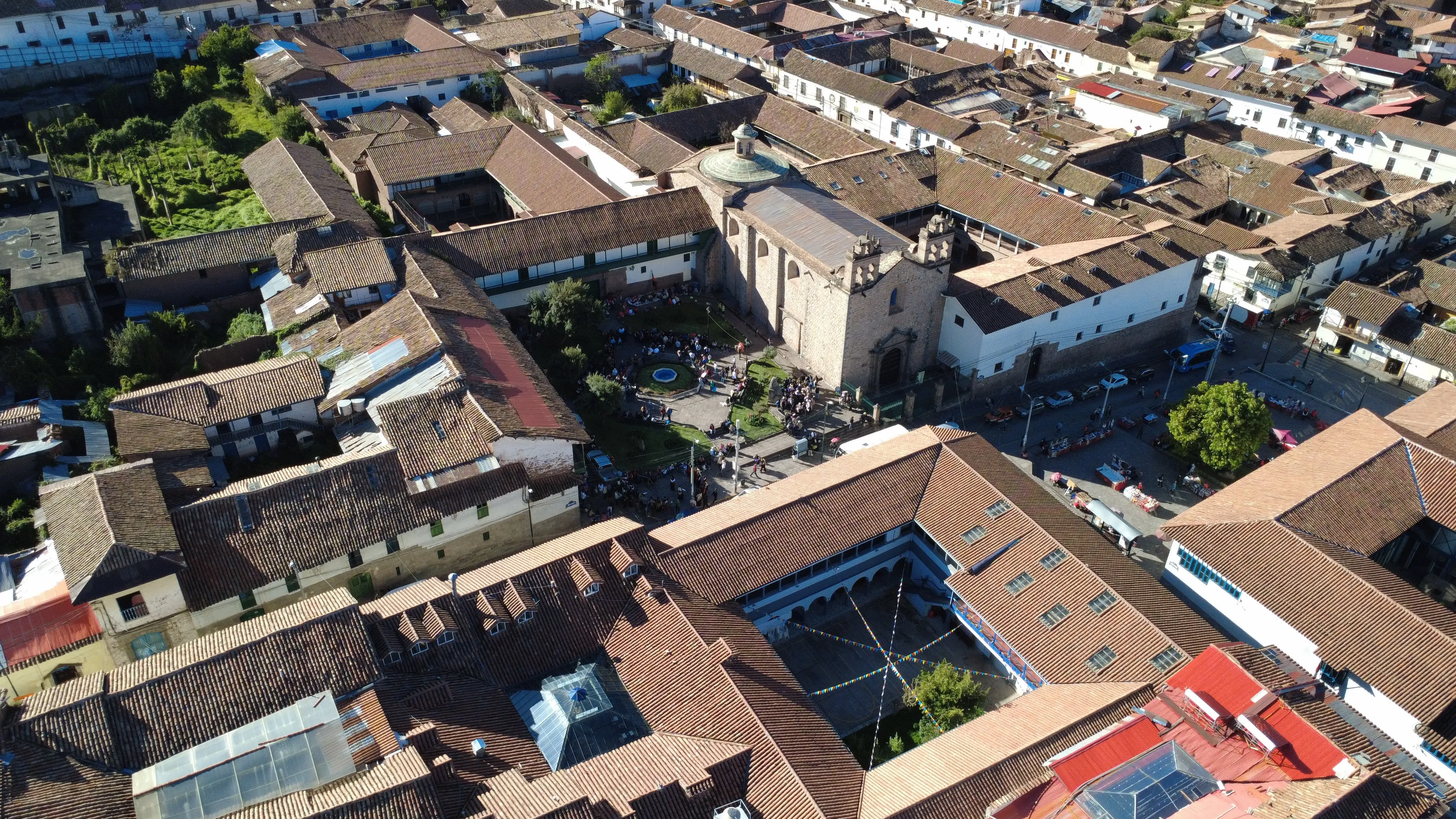
The Muro Killke Sign The information plaque on Calle Sunturwasi. It shows excavation photos and explains how this Killke wall helped define the pre-Inca city layout. |
Stop 6: a quick dive into history and the Inca road network

Our second stop is in front of an information board. Here, our guide drops a fact that leaves the whole group absolutely speechless: 40,000 kilometers. That is the total length of the Inca road system, the Qhapaq Ñan, which stretched from present-day Colombia all the way to Chili, crossing deserts, high mountains, and dense forests.
To put that into perspective, it's roughly equivalent to the circumference of the Earth. And all of this was built without wheels, horses, or a written language. Suspension bridges woven from plant fibers spanned deep ravines, while "tampus" (wayside stations) were spaced a day's walk apart. "Chasquis" (highly trained messenger-runners) worked in relays, carrying messages from Cusco to Quito in just 5 days—faster than any Spanish horseman.
The famous Inca Trail to Machu Picchu is actually just a tiny fragment of this colossal network. In 2014, UNESCO rightfully declared it a World Heritage site, cementing its status as one of the greatest engineering feats in human history.
Stop 7: Puma y Serpiente de piedra – spot the animals hidden in the walls
Our guide pulls us up in front of a wall and asks, "Do you see the puma? And the snake?" We squint our eyes and, suddenly, there they are. Carved into the stonework: the shape of a puma on one wall and a snake on another facade.
The Incas often integrated animal shapes into their buildings—llamas, snakes, condors, and pumas. This wasn't just for decoration; each animal held a deep cosmological meaning.
In fact, Cusco itself is said to have been designed in the shape of a puma by Pachakútec. Sacsayhuáman makes up the head, and Coricancha forms the tail. When you look down over the city from the heights, the shape is surprisingly easy to spot.
The 3 Inca Worlds Hanan Pacha (the sky, represented by the condor), Kay Pacha (the earth, the puma), and Ukhu Pacha (the underworld, the snake). This cosmological trinity shaped all of Inca architecture and art. Once you know what to look for, you'll start spotting it everywhere in Cusco. |
The next part of our free walking tour
Stop 8: Plaza San Blas, the artisans' quarter
We head up. The alleys narrow, the cobblestones get a bit more uneven, and suddenly we emerge onto Plaza San Blas, the heart of Cusco's artisan district.
San Blas is one of the oldest neighborhoods in the city, continuously inhabited since Inca times. It was the barrio of artists and craftsmenu2014ceramists, sculptors, weaversu2014and it has stayed that way. Today, workshops and galleries line the cobbled streets, and this is where you'll find the most authentic handmade crafts in Cusco.
The San Blas Church on the square houses a carved wooden pulpit famous throughout Latin America, a masterpiece of colonial art created entirely from a single cedar trunk. Legend has it that the skull at the top of the pulpit belongs to the sculptor himself, who asked to be buried within his life's work.
The vibe here is a world apart from the rest of Cusco: quieter, more bohemian. Think cafés with flower-filled courtyards, whitewashed walls, and blue doors. You can easily see why artists made this place their home.
Stop 9: San Blas Viewpoint, Cusco at your feet
Just a few steps above the square, the San Blas viewpoint offers a sweeping panoramic view over Cuscou2019s red-tiled roofs and the surrounding mountains. Itu2019s the perfect spot to get your bearings and understand the cityu2019s geography.
Our guide takes this opportunity to point out Sacsayhuamán hill to the north, the "head of the puma." The fortress's massive stone walls are visible even from here. Some of these stones weigh up to 300 tons and stand 9 meters tall. The Spaniards dismantled most of the site to use the stone for their own buildings, leaving behind only the blocks that were simply too colossal to move.
Up there, every June 24th, Inti Raymi is celebratedu2014the reenactment of the Inca Festival of the Sun and Cusco's biggest cultural event. Thousands of actors in traditional dress recreate the ancient ceremonies of the Empire before tens of thousands of spectators.
From this vantage point, you can also see the valley stretching southeast toward the Sacred Valley and, ultimately, Machu Picchu. The entire land of the Incas unfolds right before you.
Stop 10: Sapantiana Aqueduct, water flowing through the centuries
We head back down through narrow alleys and stumble upon a quiet yet fascinating structure: the Sapantiana Aqueduct. Built by the Jesuits in the 17th and 18th centuries, this colonial aqueduct rests on top of Inca foundationsu2014once again, showcasing the historical layering that defines Cusco.
Its stone arches channeled water from high mountain springs straight into the heart of the city. The Incas were remarkably sophisticated in their water managementu2014with canals, ritual fountains, and drainage systemsu2014and the Spanish colonizers chose to repurpose this brilliant infrastructure rather than replace it.
The Sapantiana Aqueduct is one of the few visible remains of this shared colonial-Inca water network. Most tourists walk right past without noticing, but it stands as a silent witness to the connection between two worlds: the Inca and the conquerors.
Stop 11: Huaca de Sapantiana, the sacred place of water rituals
Right next to the aqueduct lies an even older site: the Huaca de Sapantiana. In Quechua, "sapantiana" means "the place where the huaca stands alone"u2014a secluded, sacred spot dedicated to the worship of water.
Huacas were sacred sites in the Inca worldu2014rocks, springs, caves, or natural formations believed to be inhabited by spirits. The Huaca de Sapantiana was closely tied to water and fertility rituals. Here, you'll see channels carved directly into the rock, ritual basins, and ceremonial niches where Inca priests once made offerings to the water deities.
Water was sacred to the Incasu2014a source of life and the thread connecting the three cosmological worlds. This low-key spot, far from the busy crowds of Plaza de Armas, offers a truly intimate look into Inca spirituality. It's one of those hidden gems you'd likely never find without a local guide.
Huacas made up the sacred fabric of Cusco. The Inca city had over 300 huacas, linked by imaginary lines (ceques) radiating out from Qorikanchau2014like a spiritual network laid over the city's streets. |
Stop 12: Calle 7 Borreguitos, Cusco's most photogenic street
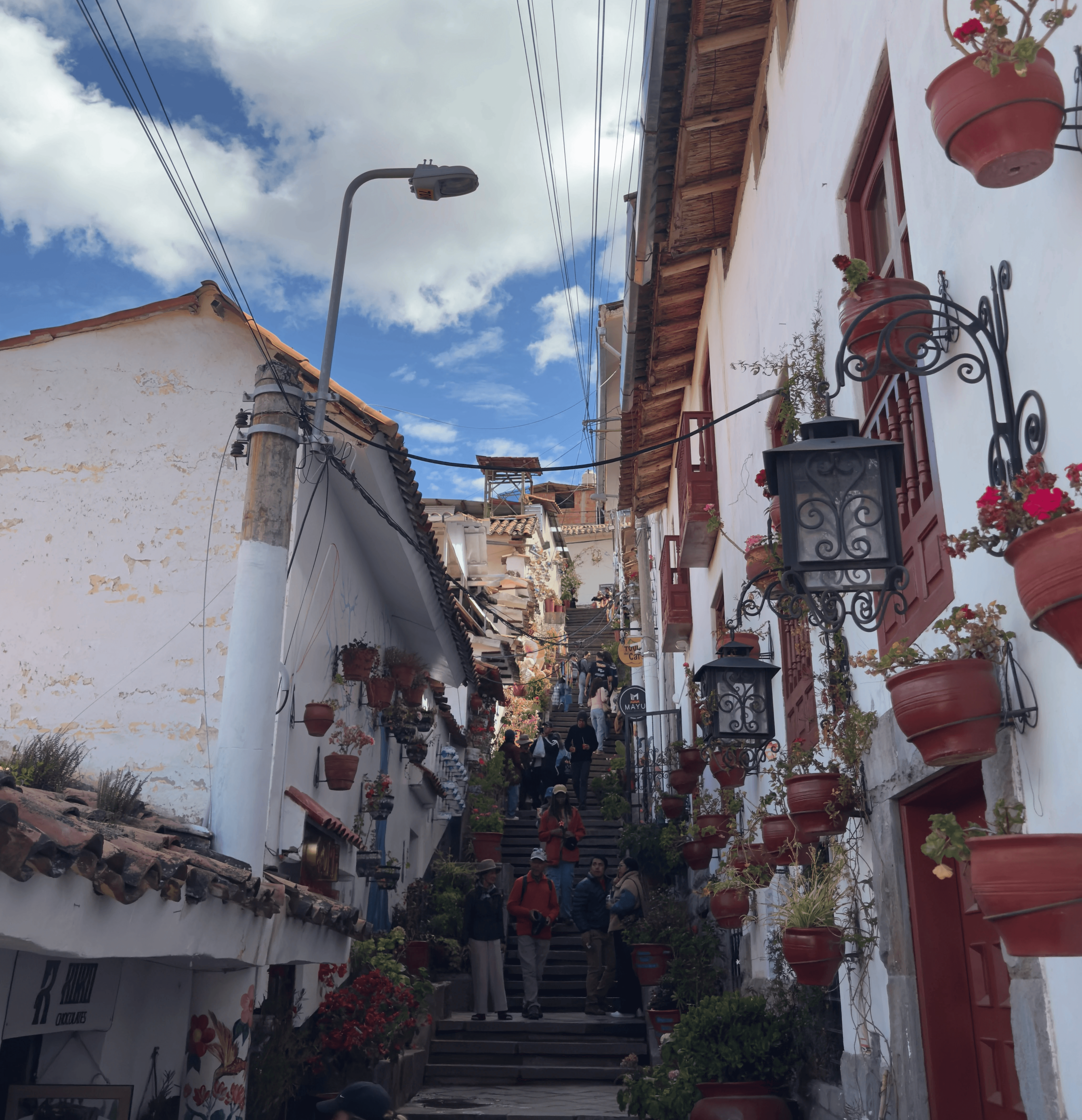
Making our way back down toward the center, our guide leads us through Calle 7 Borreguitos, and you can instantly see why it has become one of the most photographed spots in Cusco.
This narrow, charming street is bordered by whitewashed walls, colorful flowerpots hanging from the facades, and old wooden doors. Stone stairs climb gently between colonial houses. It is Andean charm at its finestu2014Instagram got this one right, and for good reason.
But beyond the picture-perfect view, our guide reminds us that these narrow passageways are a direct result of Inca urban planning. The Spaniards built their colonial homes exactly along the grid of the Inca streets, which were designed to hug the natural slope of the mountain. Even here, you are walking in the footsteps of the Incas.
The name "7 Borreguitos" ("7 Little Lambs") reportedly comes from a local legend about shepherds bringing their flocks down from the heights of San Blas to the city center. A lovely, poetic name for an equally lovely street.
Stop 13: Sunset Spot, sounds of nature and a perfect farewell
Our final stop, and the one that stayed with us the most. Our guide takes us to a west-facing viewpointu2014the perfect spot to catch the sunset as the daily tours wrap up.
He pulls out replicas of ancient Inca musical instruments and begins to play. That's when it all clicks. The Incas designed instruments to mimic the sounds of nature: birdsong, flowing water, the wind whistling through the peaks. Bone flutes, ceramic animal whistles, lama skin drums... every sound was tied to a ritual, a season, or a ceremony.
When the guide blows into a bird-shaped whistle and the sound is indistinguishable from a real Andean bird, the entire group gets goosebumps. Itu2019s a magical moment of connection with a civilization that passed 500 years ago, and there is no better way to end the tour.
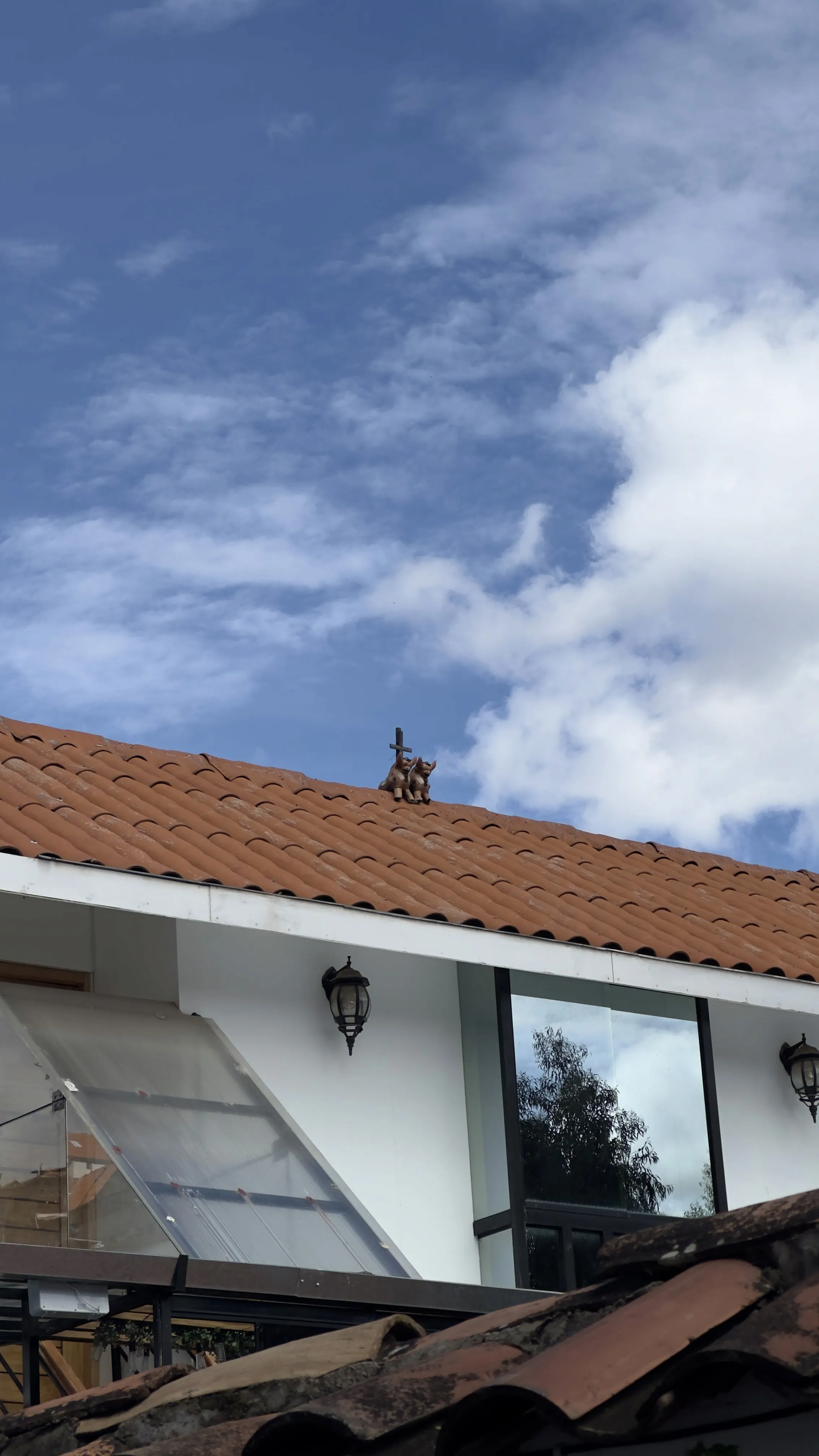
As the sun sets over Cusco, the tiled roofs glow red, and the silhouettes of the Toritos de Pucará stand out against the evening sky. Just as they have for centuries.
What will the weather be like for your trip?
The Toritos de Pucará, the guardians of the rooftops
If you look up, you'll spot small ceramic bull statues perched on the roofs. They're absolutely everywhere, sitting in pairs right on the ridge of the houses.
These are the Toritos de Pucará, a beautiful Andean tradition dating back to colonial times. Whenever a family moves into a new home, they place a pair of these ceramic bulls on the roof to bring good luck, prosperity, and protection to their household. The bulls always come in pairs—one male and one female—originating from the town of Pucará in the Puno region. It's one of those charming little details you might miss at first, but once someone points it out, you'll start spotting them everywhere you go.