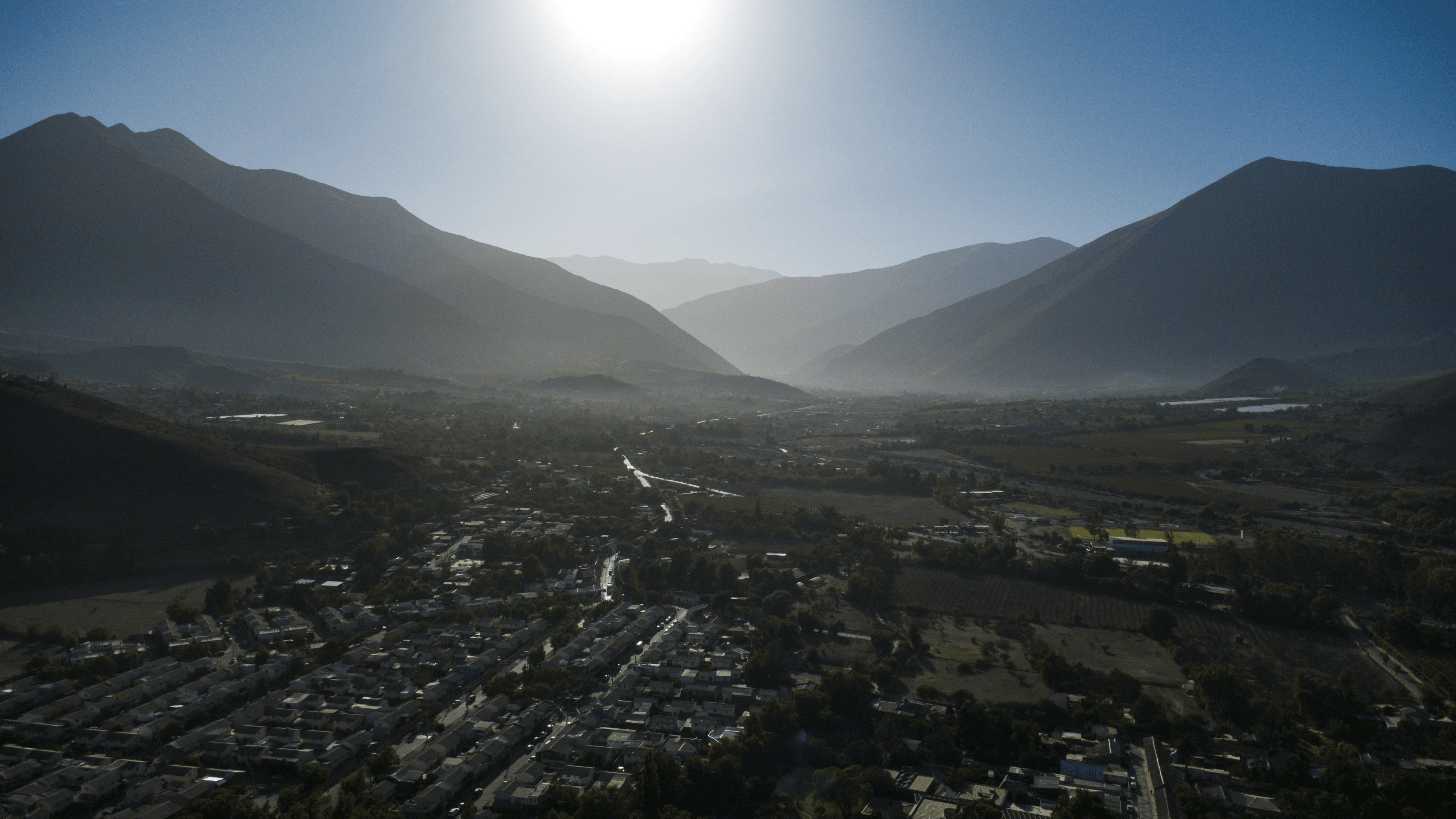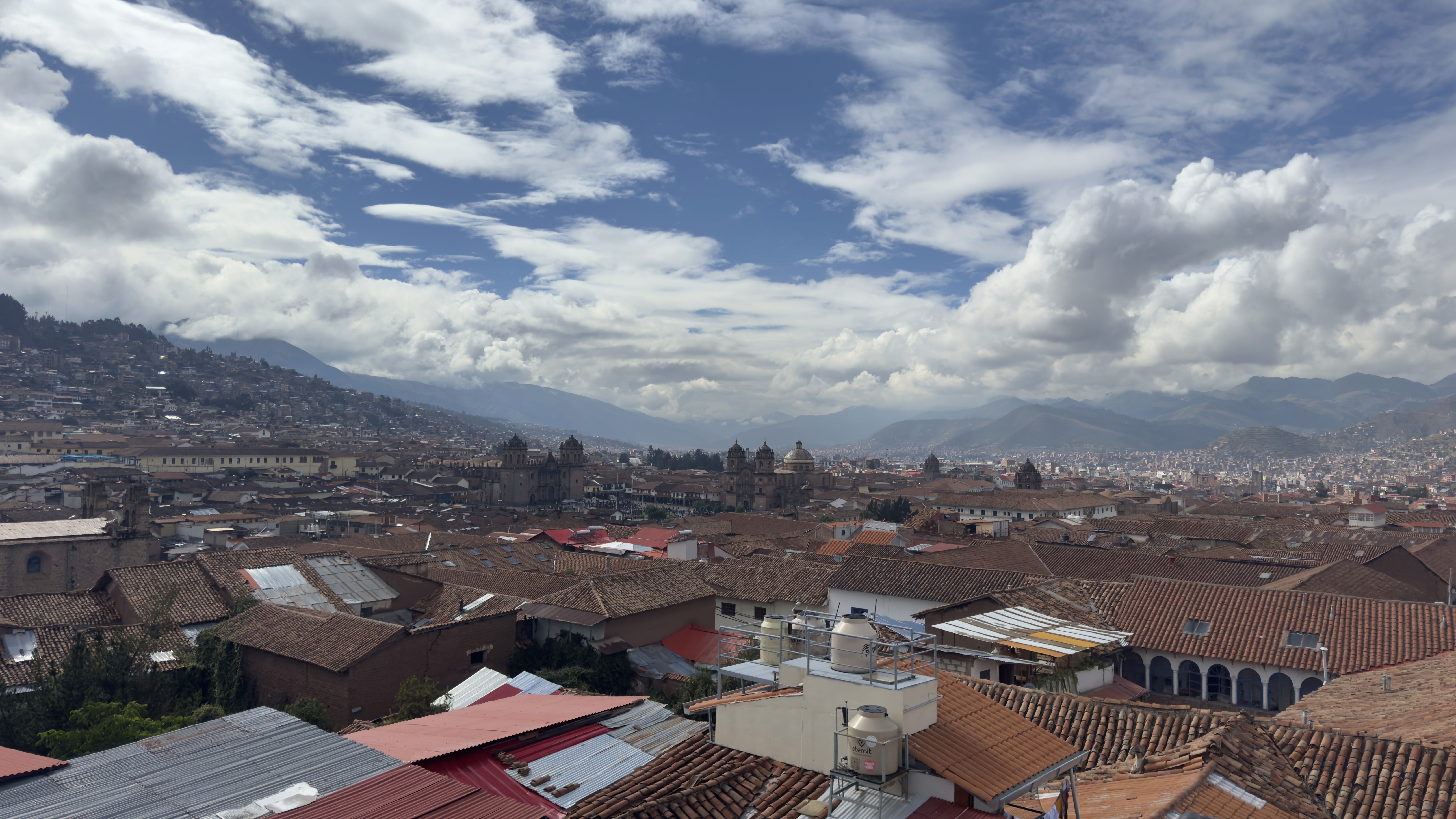
A free walking tour of Cusco with its history. How to discover Cusco by strolling through its streets.
Free Walking Tour in Cusco
Cusco on foot, history around every corner
When we arrived at the Plaza de Armas, short of breath and a little light-headed (welcome to 3,400 meters), we thought a free walking tour would be a good way to set the scene before exploring on our own. We got to discover 3,000 years of history in 3 hours of walking.
What we discovered is that Cusco is not a city with ruins. It is a city built ON centuries-old foundations, which themselves were built on even older foundations. Three civilizations stacked like a stone mille-feuille. And once you understand that, you never look at a single wall the same way again.
Here is the route we followed, the stories we heard, and what stood out to us. If you pass through Cusco, this walking tour is the best investment of your first morning.
Practical info Free walking tours leave every day at 10 a.m., 1 p.m. or 3 p.m. from the Plaza de Armas (look for the guides with colorful umbrellas). Duration: 2.5-3 hours. Free, tip at your discretion (S/20-40 suggested). Bring water, sunscreen and a fleece; at this altitude, the sun burns and the wind freezes you. |
Stop 1: Plaza de Armas, the meeting point
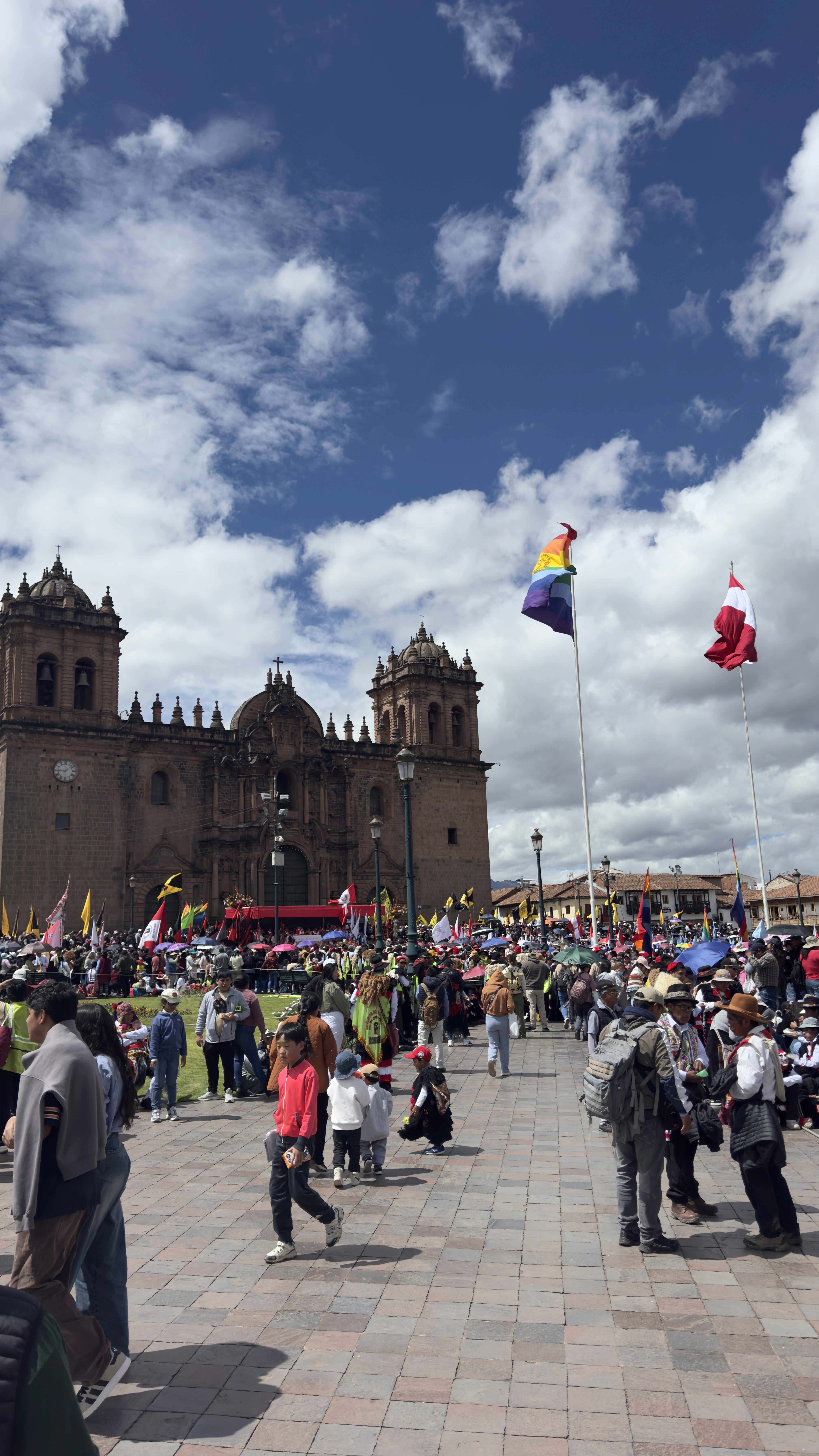
Everything starts here, Plaza de Armas. It's the meeting point for free walking tours; look for the guides with their colorful umbrellas and the small groups that form.
Before even moving, the guide sets the scene. When arriving in Cusco, the first thing that surprises you are the multicolored flags fluttering everywhere. A rainbow flag? No, it's the official flag of the city of Cusco. This flag takes up the colors of Tawantinsuyu (the Inca Empire) and represents the four regions of the Empire. It was adopted in 1978 by the municipality of Cusco as a symbol of regional identity.
Fun little detail: the Cusco flag was created 11 years before the LGBT rainbow flag (1989). The two have nothing to do with each other, but tourists constantly confuse them. Cusqueños are half proud, half resigned about it.
The guide also reminds us that Cusco is not a museum: it's a city of 600,000 inhabitants, growing fast. Modern neighborhoods spread around the historic center, the markets overflow, and the students from San Antonio Abad University mingle with tourists on the Plaza.
The guide starts with a question: « Do you see this magnificent square? Now imagine it twice as large. »
Because today's Plaza de Armas is only half of the original Huacaypata, the Inca ceremonial square that was the absolute center of the Empire. The Spanish shrank it, destroyed the Inca palaces that surrounded it, and built their churches and colonial mansions on top. But, and this is where it gets fascinating, they kept the Inca foundations.
Why? Because the Inca stones were too finely cut, too massive, and too perfectly fitted together to be destroyed. So the colonists made do. Result: even today, every building around the square rests on Inca walls. Below, the surgical precision of the Incas. Above, Spanish Baroque. The contrast is everywhere.
The shadow of Pachakútec
And that guy standing at the center of it all is Pachakútec, the 9th Inca emperor, the one who changed everything. Before him, the Incas were just one mountain people among others. After him, they controlled an empire 4,000 km long. He was the one who transformed Cusco into an imperial capital, had the Coricancha (Temple of the Sun) built, and launched the construction of Sacsayhuáman. In Quechua, his name means « He who transforms the world », and he did not steal the title.
His golden statue towers over the Plaza, arm raised, gaze toward the mountains. The guide explains that Pachakútec did not just expand the borders, he reorganized the Empire into 4 regions (the Tawantinsuyu), set up a system of roads, public granaries, and a remarkably efficient administration. All that without writing. The Incas used quipus, knotted cords, to keep track of everything.
Inca hierarchy: a well-ordered pyramid
The guide pulls out a pyramid-shaped diagram and explains the social structure of the Empire. At the top, the Inca, the emperor, son of the Sun. Just below, the Realeza (the royal family): the Auqui (the crown prince) and the Panacas Reales, the descendants of each previous emperor. Then the Nobility, the blood nobility (distant relatives) and the nobility of privilege (meritorious officials). Finally, the People, organized in ayllus (communities), who cultivated the land and built the roads.
What stands out is that the system was redistributive: taxes were paid in labor (the mita), and in return the state guaranteed food, clothing, and protection. No money, no market. Everything was centralized and redistributed. A system that fed 10 million people without anyone starving, at least according to the chroniclers.
Stop 2: Notre-Dame-de-l'Assumption Cathedral
We’re not leaving the Plaza yet. Cusco Cathedral is a Baroque masterpiece. But when the guide asks us to look at the paintings more closely, we understand that they tell a story of silent resistance.
After the conquest, the Spaniards wanted to impose Catholicism. They commissioned hundreds of religious paintings. The problem (for the colonizers): the painters were Indigenous artists. And those artists slipped their own symbols into the biblical scenes.
Look at Cusco’s paintings like a treasure hunt: every Andean symbol hidden in a biblical scene is a message from the artists to their own people. |
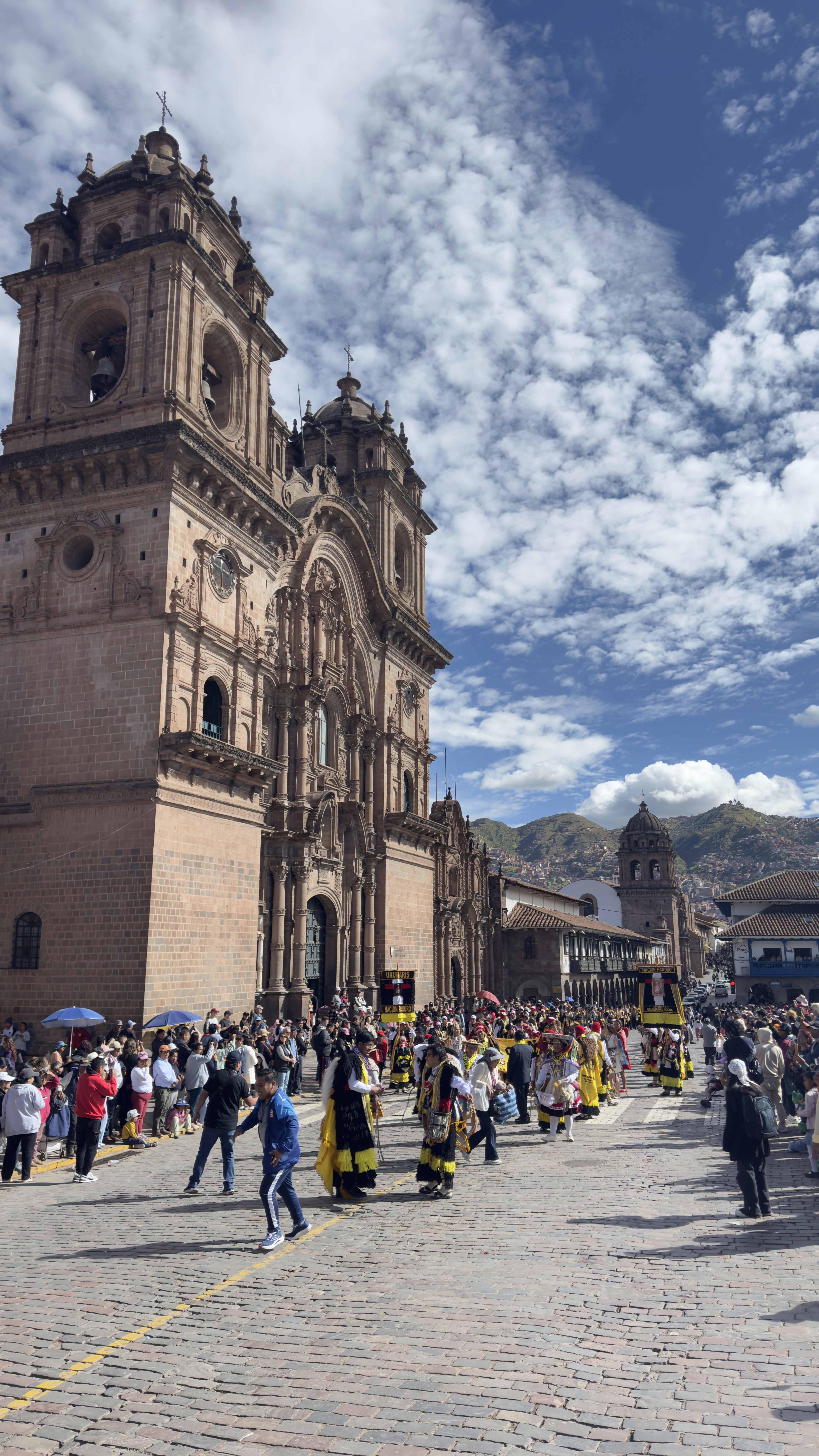
The Virgin Mary wears a triangular dress that evokes Cerro Rico de Potosí (the silver mountain, symbol of Pachamama). The cathedral's most famous Last Supper shows Jesus and his disciples seated before… cuy (roasted guinea pig) and glasses of chicha. Local fruits replace European bread and wine. Inca suns appear in the halos of the saints.
This is what is called the Cusqueñan School of painting, an artistic movement born from the (forced) encounter between two cultures. Indigenous painters obeyed the Catholic commission while preserving their identity. Each painting is an act of resistance disguised as devotion.
Stop 4: Calle Loreto, the Inca walls and the House of the Chosen Women
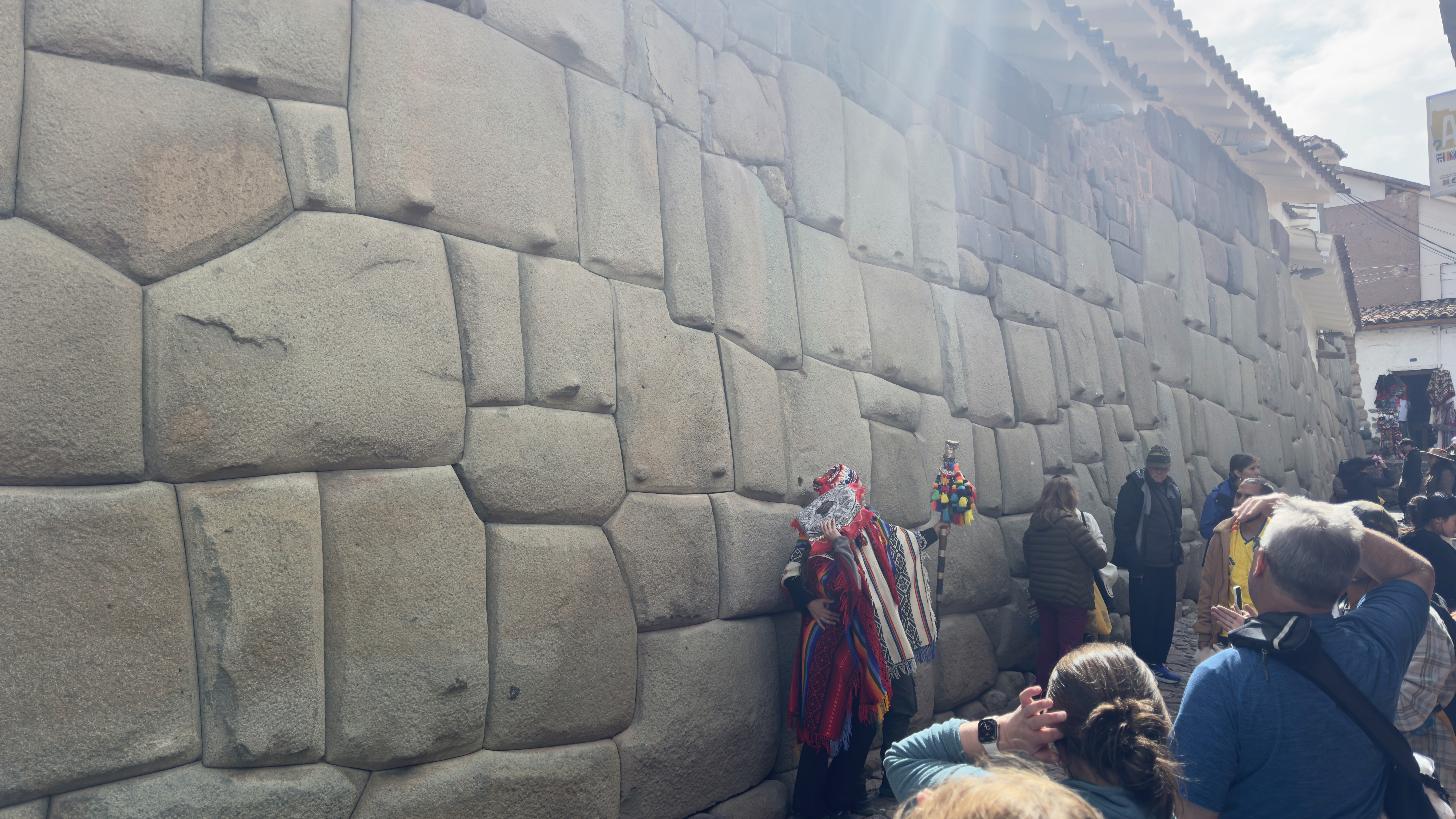
We leave the square via calle Loreto, a narrow lane lined with Inca walls on both sides. And there, the guide stops us and asks: « Do you see any mortar anywhere? »
No. Because there isn't any.
The Inca stones are cut and fitted together like Lego pieces, with such precision that you can't slip a knife blade between them. Each stone has a unique shape, cut to fit perfectly with its neighbors. This is what's called polygonal masonry, and it's what makes Inca constructions earthquake-resistant. During the 1950 earthquake, the colonial buildings collapsed. The Inca walls underneath? Didn't budge an inch.
The carving technique: water, wood, and patience
How did they carve these massive stones without metal tools? The guide shows us. The Incas first made a cut in the rock, then inserted wooden wedges into the crack. Then they poured water over the wood. As it swelled, the wood exerted enormous pressure that split the stone with surgical precision. Simple, brilliant, effective. The faces were then polished by rubbing with sand and other stones.
L'Aqllawasi, the House of the Chosen Women
On the left side of Calle Loreto, the guide points out a particular wall. This was the site of the Aqllawasi, one of the most important buildings in the Empire, and one of the least known.
The Aqllawasi was an institution reserved for women. The “Acllas” (“chosen women”) were selected throughout the Empire for their beauty, intelligence, or skills. They received a complete education: weaving fine textiles, preparing chicha (sacred corn beer), religious rituals, and astronomy.
What is remarkable is that the Incas were among the first to formalize professions specifically for women. The best weavers, the priestesses, all had a defined and respected role in society. In an ancient world often exclusively male, women’s place in Inca society was particularly structured and valued.
The Aqllawasi was both a convent, a school, and a center for luxury textile production. It was one of the most imposing palaces in Cusco. |
Stop 5: Twelve-Angled Stone, the 12-Angled Stone and the Killke ghosts
Before the Incas: the Killke people
Under the cobblestones of Calle Sunturwasi, a few meters from the Stone of 12 Angles, archaeological excavations have revealed a buried wall dating from 800 A.D., 500 years before the Incas. This wall belongs to the Killke civilization.
The Killke lived in the Cusco region well before the arrival of the Incas. They already had an urban organization, built in stone (limestone for the foundations, diorite for the walls), and had laid out streets that match the current plan of Cusco and are shaped like a puma. Hatunrumiyoc Street itself follows the route of an ancient pre-Hispanic path that connected Cusco to the Antisuyo region (the Amazon).
It is a street that people have been using for at least 1,200 years.
The Muro Killke sign The information panel on Calle Sunturwasi. It shows photos of the excavations and explains how this Killke wall defines a pre-Inca urban layout. |
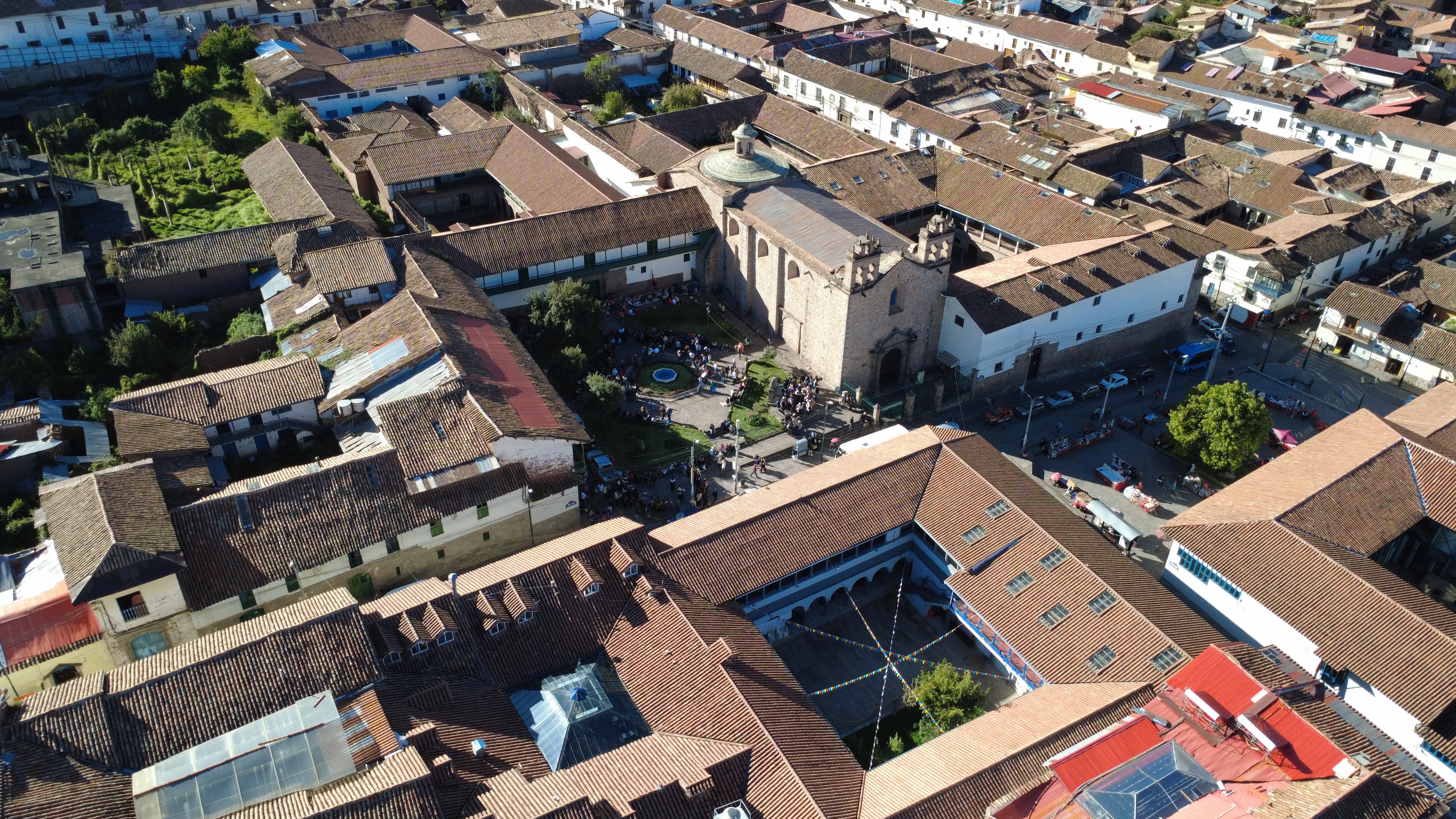
Stop 6: History break and Inca road network
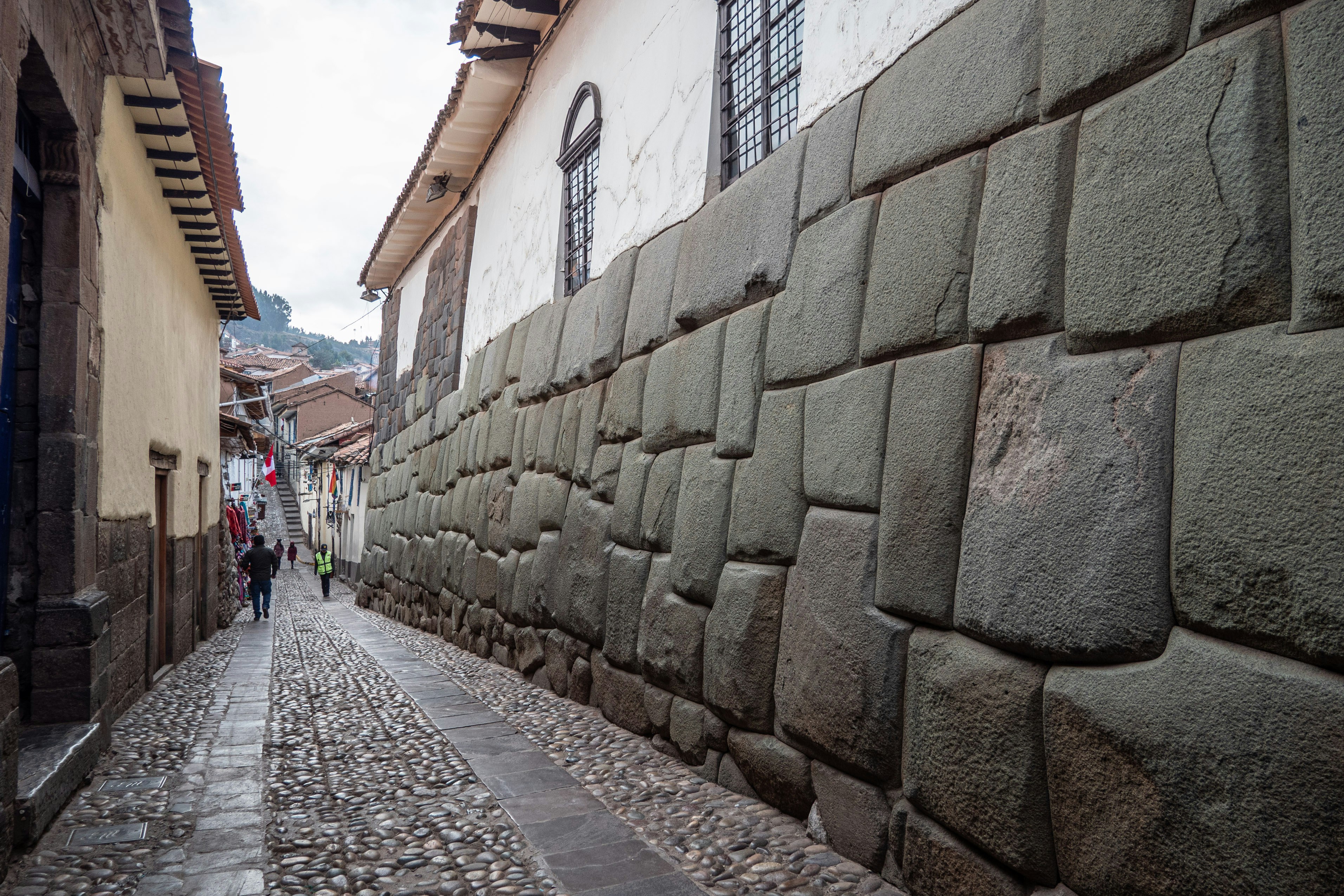
Second stop in front of an explanatory panel. The guide takes the opportunity to drop a figure that leaves the whole group stunned: 40,000 kilometers. That is the total length of the Inca road network, the Qhapaq Ñan, which stretched from present-day Colombia to Chili, crossing deserts, mountains, and forests.
To put it in perspective: it is equivalent to the Earth’s circumference. All this was built without the wheel, without horses, and without writing. Suspension bridges made of plant fibers spanned the ravines. Tampus (way stations) were spaced a day’s walk apart. Chasquis (runner-messengers) took turns and could deliver a message from Cusco to Quito in 5 days, faster than a Spanish horseman.
The famous “Inca Trail” to Machu Picchu is only a tiny fragment of this colossal network. UNESCO listed it as a World Heritage site in 2014, one of the greatest feats of engineering in human history.
Stop 7: Puma and Stone Snake, the animals hidden in the walls
The guide stops us in front of a wall and asks: « Do you see the puma? And the serpent? » We squint. And suddenly, we see them. In the arrangement of the stones, the silhouettes of a puma on one wall and a serpent on another façade.
The Incas had a habit of integrating animal forms into their constructions, llamas, serpents, condors, pumas. It was not decorative: each animal had cosmological significance.
Cusco itself is said to have been designed in the shape of a puma by Pachakútec. Sacsayhuáman forms the head, the Coricancha the tail. When you look down on the city from above, the shape is surprisingly recognizable.
The 3 Inca worlds Hanan Pacha (the sky, the condor), Kay Pacha (the earth, the puma), Ukhu Pacha (the underworld, the serpent). This cosmological trinity structures all Inca architecture and art. Once you know it, you find it everywhere in Cusco. |
The rest of the free walking tour
Stop 8: San Blas Square, the artisans' district
We go uphill. The alleys narrow, the cobblestones become more uneven, and suddenly we emerge onto Plaza San Blas, the heart of Cusco's artisans' district.
San Blas is one of the oldest neighborhoods in the city, inhabited continuously since Inca times. It was the barrio of artists and artisans, potters, sculptors, weavers, and it still is. Today, workshops and galleries line the cobbled streets, and this is where you find Cusco's most authentic handicrafts.
The San Blas church, on the square, houses a famous carved wooden pulpit known throughout Latin America, a masterpiece of colonial art made entirely from a single cedar trunk. Legend has it that the skull atop the pulpit is that of its sculptor, who supposedly asked to be buried in his work.
The atmosphere here is different from the rest of Cusco: calmer, more bohemian. Cafés with flower-filled courtyards, white walls, blue doors. You understand why artists chose it.
Stop 9: San Blas View Point, Cusco at your feet
A few steps above the square, the San Blas viewpoint offers panoramic views over Cusco's red-tiled roofs and the mountains surrounding it. It's the best viewpoint to understand the city's geography.
The guide takes the opportunity to show us Sacsayhuamán hill to the north, the "head of the puma". The cyclopean walls of the fortress are visible even from here. Some stones weigh 300 tons and are 9 meters high. The Spaniards dismantled most of the site to use the stones in their own constructions. Only the stones too enormous to be transported remained in place.
That's where, every June 24, Inti Raymi takes place, the reenactment of the Inca sun festival, Cusco's largest cultural event. Thousands of extras in traditional costumes recreate the ceremonies of the Empire before tens of thousands of spectators.
From this viewpoint, you can also see the valley stretching to the southeast, in the direction of the Sacred Valley and, beyond it, Machu Picchu. The entire Inca territory unfolds before you.
Stop 10: Sapantiana Aqueduct, water that spans the centuries
We head back down through narrow streets and come upon a discreet but fascinating structure: the Sapantiana aqueduct. Built by the Jesuits in the 17th-18th centuries, this colonial aqueduct rests on Inca foundations, once again this layering that defines Cusco.
The stone arches channeled water from the springs in the heights down to the heart of the city. The Incas had already mastered hydraulics with remarkable sophistication, canals, ritual fountains, drainage systems, and the Spanish colonists reused this infrastructure rather than replacing it.
The Sapantiana aqueduct is one of the few visible remains of this colonial-Inca hydraulic network. Most tourists pass by without noticing it, but it is a silent witness to the continuity between the two worlds, that of the Incas and that of the conquerors.
Stop 11: Huaca de Sapantiana, the sacred place of water rituals
Right next to the aqueduct is an even older site: the Huaca de Sapantiana. In Quechua, "sapantiana" means "the place where the huaca stands alone", a secluded sacred place dedicated to the worship of water.
Huacas were holy places in Inca cosmology, rocks, springs, caves or natural formations inhabited by spirits. The Huaca de Sapantiana was linked to water and fertility rituals. There are channels carved into the rock, ritual basins and ceremonial niches where Inca priests made offerings to water deities.
Water was sacred for the Incas, a source of life, a link between the three cosmological worlds. This discreet site, far from the crowds of the Plaza de Armas, offers an intimate glimpse into Inca spirituality. It's one of those places you would never visit without a local guide.
Huacas were the sacred fabric of Cusco. The Inca city had more than 300 huacas, linked by imaginary lines (ceques) radiating from the Coricancha, like a spiritual network superimposed on the road network. |
Stop 12: Calle 7 Borreguitos, the most photogenic street in Cusco
On the way back down toward the center, the guide takes us through Calle 7 Borreguitos, and we immediately understand why it has become one of Cusco's most photographed spots.
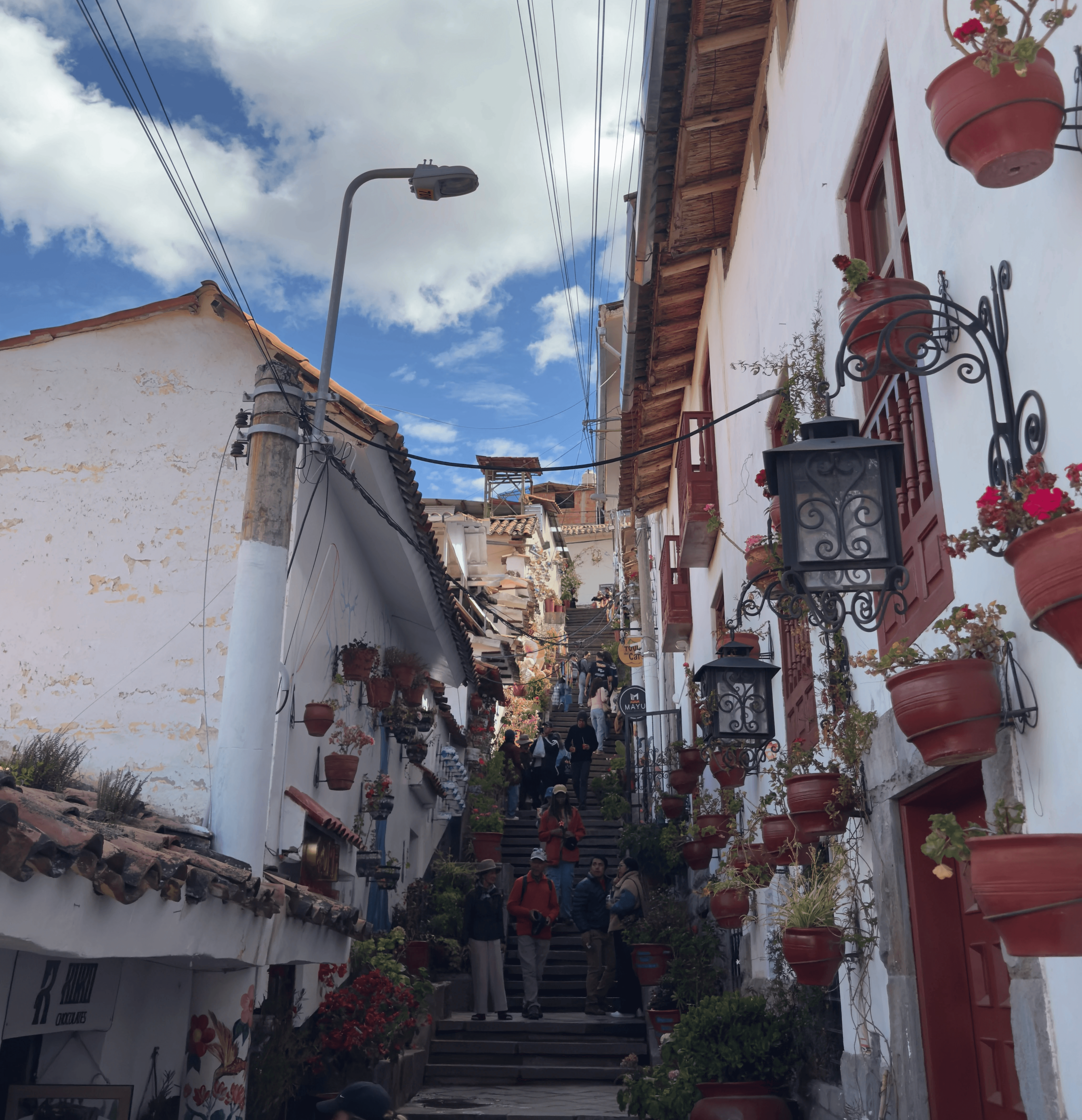
The street is narrow, lined with whitewashed walls, punctuated by colorful flower pots hanging from the facades and old wooden doors. Stone steps rise gently between the colonial houses. It's a concentration of Andean charm, Instagram has understood it well, and rightly so.
But behind the picturesque look, the guide reminds us that these narrow alleys are the direct result of Inca urban planning: the Spaniards built their colonial houses within the exact footprint of the Inca streets, which had already been laid out to follow the mountain slope. Even here, the Incas are beneath your feet.
The name "7 Borreguitos" ("7 little lambs") is said to come from a local legend linked to shepherds who came down with their flocks from the heights of San Blas to the city center. A poetic name for a street that is just as poetic.
Stop 13: Sunset Spot, the sounds of nature and the final word
Final stop, and the one that touched us the most. The guide takes us to a viewpoint facing west, perfect for sunset when the tour stretches toward the end of the day.
He takes out replicas of Inca musical instruments and has them played. And then it clicks. The Incas had designed instruments that reproduced the sounds of nature: birdsong, water, wind in the mountains. Bone flutes, ceramic whistles shaped like animals, llama-skin drums. Each sound was tied to a ritual, a season, or a ceremony.
When the guide makes a bird-shaped whistle sing and the sound is indistinguishable from a real Andean birdcall, the whole group gets goosebumps. It's a moment of direct connection with a civilization that disappeared 500 years ago, and it's the most beautiful way to end this tour.
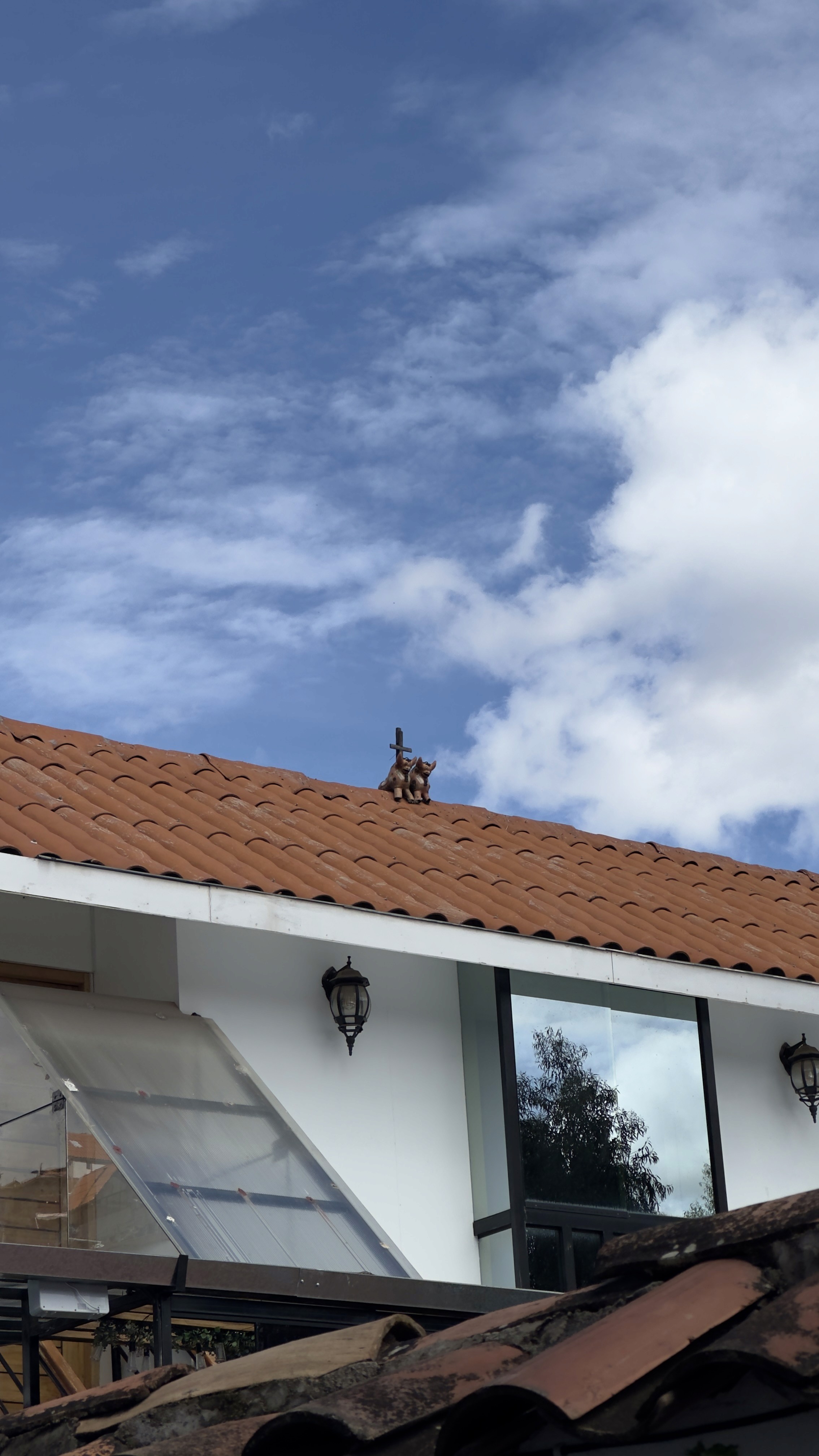
The sun sets over Cusco, the tiled roofs glow red, and the Toritos de Pucará stand out in silhouette against the sky. Just as they have for centuries.
Our interactive map
Find all our addresses, safety zones, and points of interest directly on our Google Maps map.
Tip: If you’re not sure how to use our Maps maps, we’ve put together a dedicated article to help you out!
What will the weather be like for your trip?
The Toritos de Pucará, the guardians of the roofs
Looking up, one notices small ceramic bull statues on the rooftops. They are everywhere, in pairs, perched on the ridge of the houses.
These are the Toritos de Pucará, an Andean tradition dating back to the colonial period. When a family moves into a new house, it places a pair of ceramic bulls on the roof to attract good fortune and prosperity and to protect the home. The bulls are always in pairs, a male and a female, and come from the town of Pucará, in the Puno region. It is a detail one only notices once it has been pointed out, and after that, that is all you see.