Inca engineering: the questions everyone asks
Imagine 60,000 km of roads built without wheels, 200-ton stone blocks seamlessly fitted without mortar, and suspension bridges swinging over deep canyons. On our Salkantay Trek adventure, we set out to answer the big questions about the marvels of Inca engineering.
Inca engineering: the questions everyone asks
37,000 miles of roads built without a single metal wheel. 180-ton giant stone blocks fitted together perfectly without any mortar. Suspension bridges swinging over canyons hundreds of feet deep. Our Salkantay guide asked us the one question that sums it all up: if we can't even figure out how they did it, can we honestly say we know who built it?
What took science centuries to finally understand
For centuries, Spanish chronicles depicted Andean peoples as being ignorant of astronomy, sustainable agriculture, geometry, and engineering. This view found its way into official history books, including the ones Peruvian school children themselves studied up until the 1960s.
In fact, archaeological discoveries from the 2000s onwards have been revealing quite the opposite.
The Incas, and the civilisations before them, mastered techniques that we are only just beginning to understand thanks to modern technology. Carbon-14 dating, LiDAR (laser technology used to map structures hidden under vegetation), and spectrographic analysis of rocks: over the last two decades, these tools have revealed more about Andean engineering than four centuries of traditional research ever did.
The paradox shared by our guide on the Salkantay trail still holds true: if we don't yet have the technical means to understand how these structures were built, can we really say for sure who built them? It's not just a trivial question. It challenges much of what we take for granted about official Inca history.
This isn't an invitation to get lost in mysticism or alien theories. It's simply a reminder that Andean history is still being written, and what we think we know today will almost certainly be incomplete or partly wrong in twenty years.
37,000 miles of roads: how and why?
The Inca road network is one of the most spectacular achievements in human history. We are talking about 60,000 kilometers of passable trails, cutting through jungles, deserts, high-altitude plateaus, and mountain passes higher than 5,000 meters.
To put that into perspective, the Roman roads—long considered the pinnacle of ancient engineering—reached about 30,000 kilometers. The Incas built twice as much history. And they did it without metal wheels, pack animals suitable for heavy loads, and across a geography far more challenging than that of the Roman Empire.
This network wasn't just one-size-fits-all. There were three main types of trails, each with a very specific purpose:
Trade trails connected the empire's different ecological zones: the jungle, the Andean highlands, and the coast. They allowed food and goods to be constantly redistributed across the territory, in keeping with the principle of reciprocity that bound Inca society together.
Messenger trails worked on a relay system. Runners, handpicked in their teens from the most athletic youth between 14 and 18, would sprint sections of about 8 kilometers before passing the message to the next station. The result? A message could travel 60,000 kilometers in just a few days. The 2,000-kilometer distance between Quito (Ecuador) and Cusco was covered in a mind-boggling 40 hours. No communication system in the Americas was this fast until the telegraph arrived.
The Emperor's trails were highly exclusive, reserved only for the Sapa Inca himself or anyone with his direct permission. The famous Machu Picchu Trek follows one of these imperial paths, which is part of what makes it so incredibly special.
The Qhapaq Ñan, the great road network of the Incas, has been a UNESCO World Heritage site since 2014. It spans six countries: Colombia, Ecuador, Peru, Bolivia, Argentina, and Chili. Site UNESCO Qhapaq Ñan
The Quipus: a system of writing we're still trying to fully unpack
For a long time, it was said that the Incas had no writing system. It was a convenient claim that justified labeling them as a "primitive" civilization in Spanish chronicles. The reality is much more complex.
The Incas used Quipus: a system of knotted strings of different colors, materials, and spacing, capable of encoding information with a level of sophistication that science is only just beginning to appreciate.
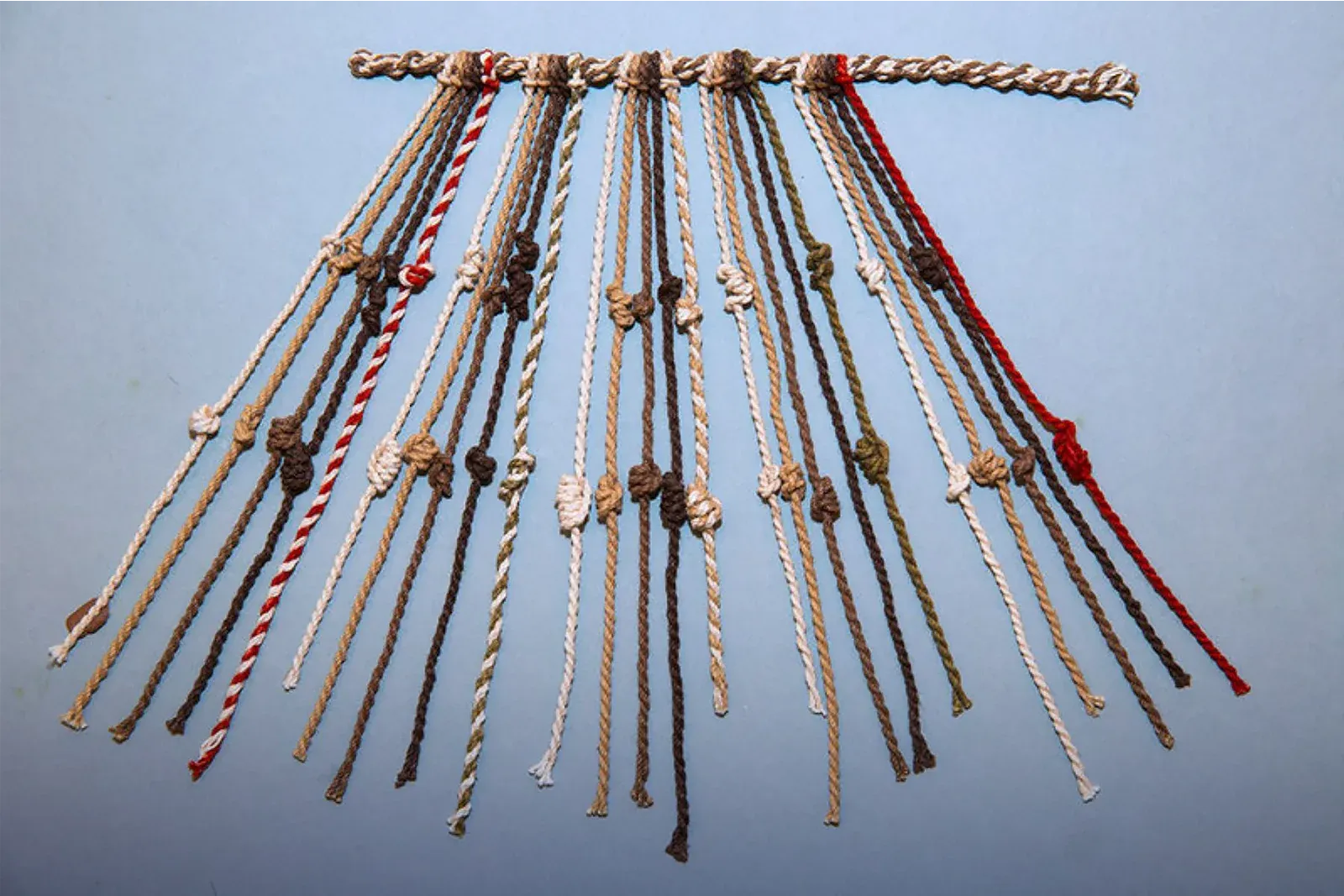
There are three distinct types of them, and they don't all work the same way.
The first type is the easiest to crack: a numerical accounting system. The knots represent units, tens, hundreds, and thousands. The colors and materials of the cords show what's being counted—whether it's corn, heads of cattle, soldiers, or sacks of grain. Archaeologists and linguists have managed to decode this type with reasonable accuracy.
The second type is much more mysterious. The cords are far more numerous, the coordinates of the knots are tightly packed, and the materials are more varied. Fewer than 50 of these have survived, and no researcher has managed to fully decode them yet. All we know is that they served as a link between community leaders and the imperial authorities. These Quipus could weigh several hundred pounds and required a team of people just to carry them.
The third type is the most recent to have given up its secrets. A researcher managed to decode 40% of its content by discovering that the name of the cord's material or the name of the color in Quechua, combined with the angle of the attached cord, created a sort of alphabet. It's not an alphabet in the Western sense, but rather a system that is both mathematical and semantic, once interpreted exclusively by a class of specialists known as Quipucamayocs.
Suspension bridges: the original zipline
The Inca road network had to traverse dozens of deep canyons across the Andes. The brilliant solution developed by Inca engineers: the grass suspension bridge, a feat of engineering that still leaves modern experts in awe today.
The longest organic suspension bridge ever discovered stretched for nearly 3 kilometers, strung between two canyon walls above a river, crafted from alpaca leather rope. Structures of this scale, built entirely from natural materials without a single piece of metal, could easily support the weight of several people at once.
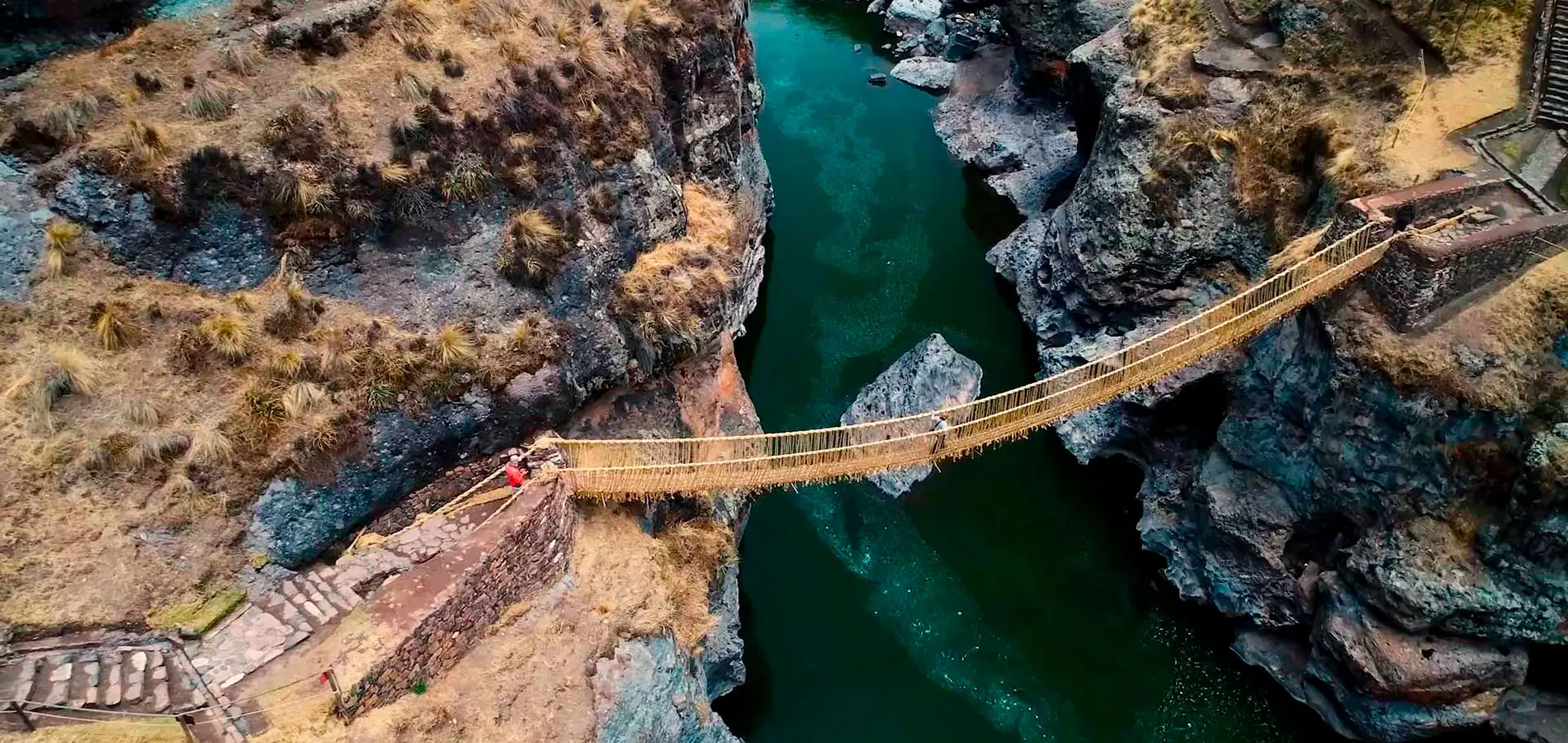
The last active Inca suspension bridge is called the Queshuachaca. Spanning 30 meters, it hangs above the Apuru00edmac River, about a 3-hour drive south of Cusco. This bridge isn't some tourist replica: it is completely rebuilt every year in June by locals from four neighboring communities, using the exact same hand-braided Ichu grass techniques passed down from Inca times. The rebuilding takes just three days, and this living tradition is recognized as Intangible Cultural Heritage by UNESCO.
On a similar note, archaeologists in the Cusco region's parks discovered an alpaca leather rope dating back some 1,400 years before the Incas. It was found at an altitude of 6,280 meters during the ascent of a Bolivian peak. This means humans were reaching heights of over 6,000 meters using nothing but leather ropes and sheer determination, long before the Inca Empire even rose to power.
The annual rebuilding ceremony of the Queshuachaca bridge takes place every June. If your travels in Peru coincide with this, it's one of the most authentic cultural experiences you can find. Queshuachaca on Google Maps
A traveler's tip: The Apuru00edmac Canyon, home to the Queshuachaca, is one of the deepest canyons in the Americas. You can easily reach it from Cusco in about half a day's drive.
The megalithic blocks: built with no mortar, no wheels, and no satisfying explanation
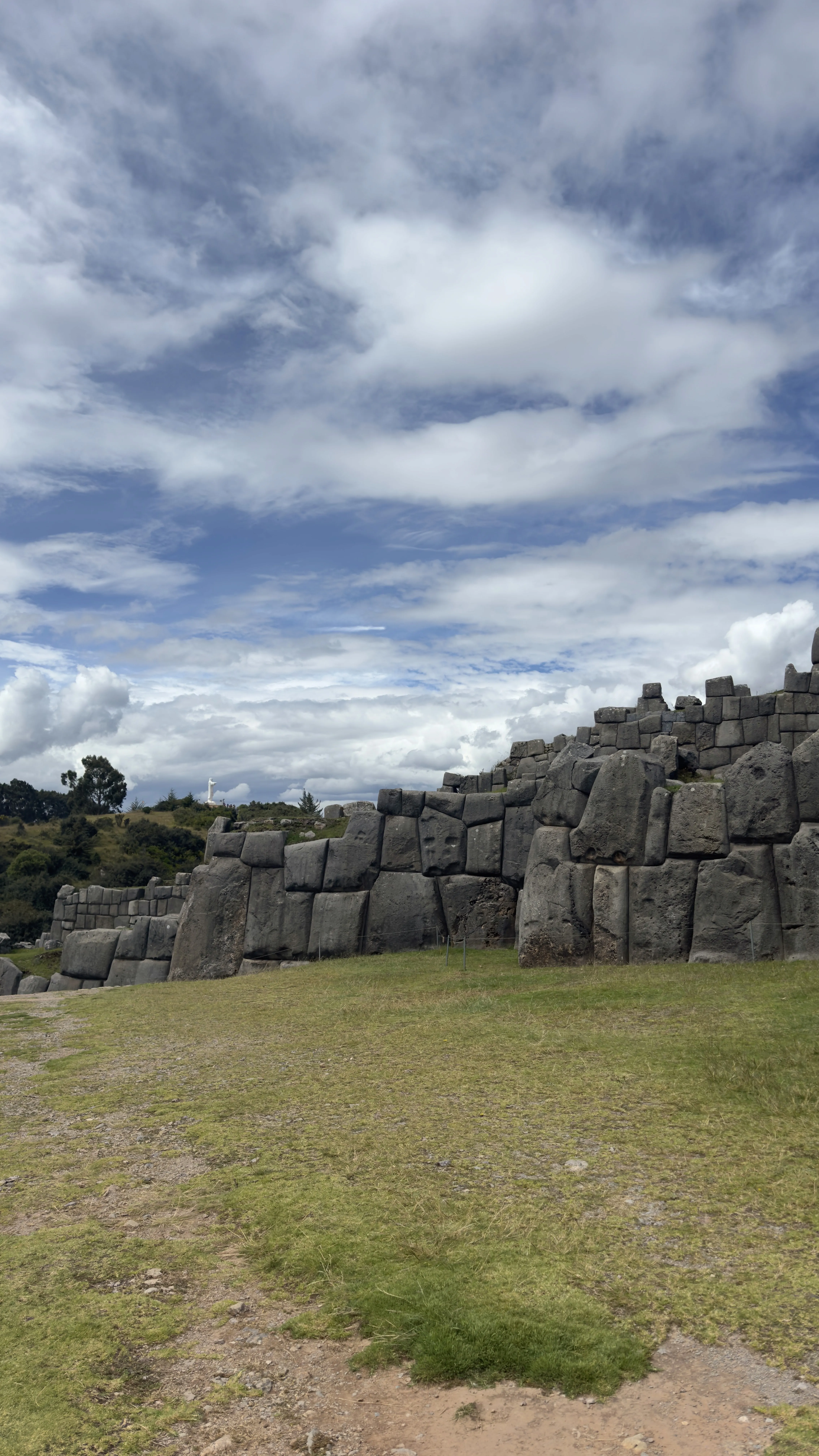
It's probably the Inca engineering question that fascinates us the most, and spawns the wildest theories: how on earth did they move and fit together stone blocks weighing between 180 and 220 tons without mortar, metal wheels, or any of the tools we consider essential today?
At the temple of the Sun (Qorikancha) in Cusco, the blocks of the megalithic base weigh between 100 and 220 tons. They are fitted together with millimeter precision, without a single drop of mortar. When an earthquake hits, the stones gently shift against one another and slide right back into place: an anti-seismic system that our modern engineers still struggle to replicate perfectly.
At the Cachicata quarry, opposite the Sacsayhuamán site, archaeologists found granite wheels that provide some of the rare physical evidence of the transport techniques they used. The blocks were fitted with tenons inserted into grooves carved into these wheels, then carefully rolled down to the river to prevent the stone from breaking. Once they crossed the river, the real stonework began on-site.
But transport alone doesn't explain the mind-boggling precision of the stonework. In 2007, and again in 2016, highly advanced scientific analyses of the rock composition at certain Inca sites revealed something unexpected: by reading the geological properties of these stones, you can actually deduce the Earth's diameter, its circumference, the distance to the Sun, and the speed of the Earth's orbit. These are data points that Copernicus didn't formulate in the West until much later, yet these stones seem to encode them in their own unique way.
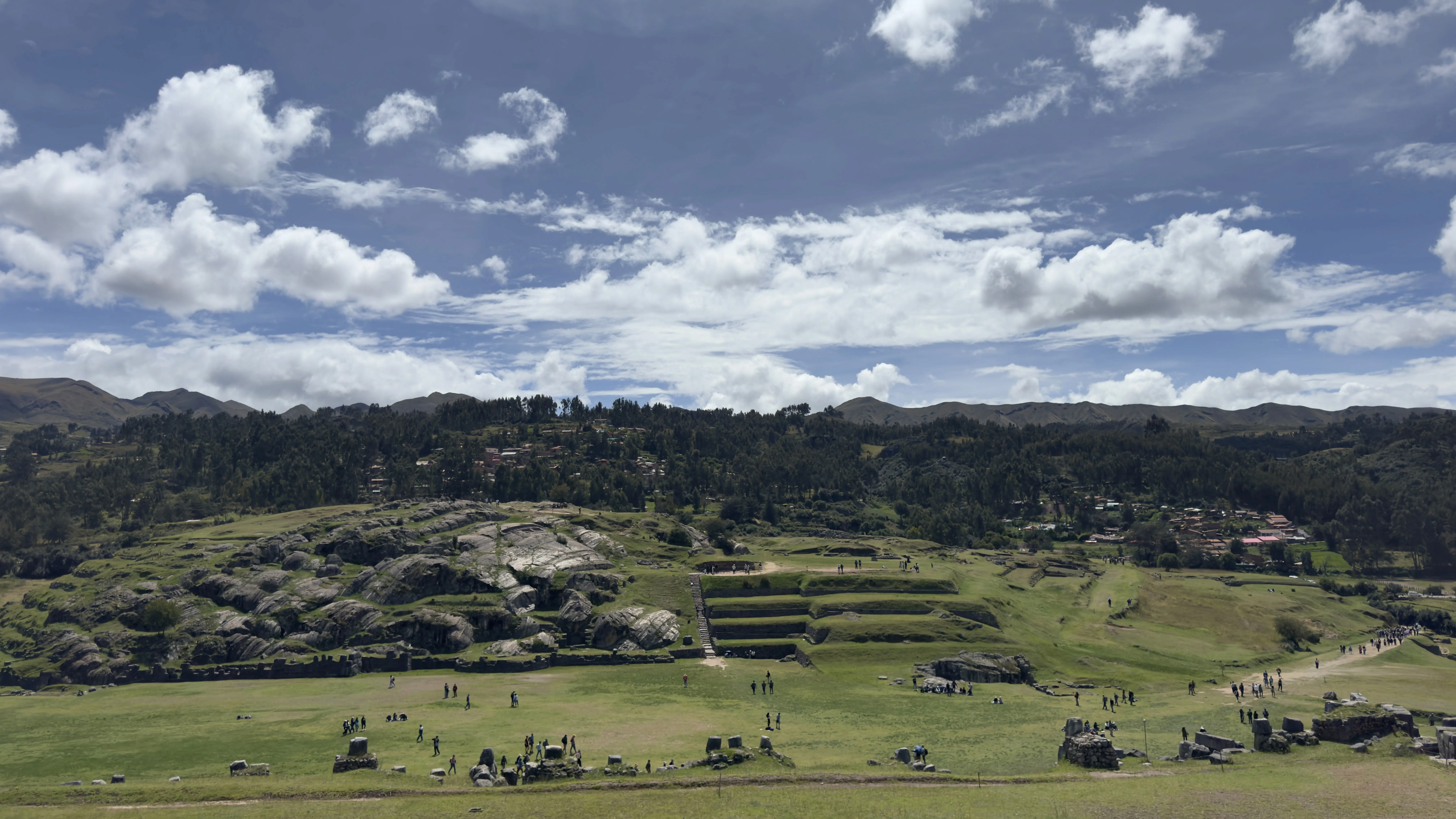
To take things further: Sacsayhuamán, just 3 kilometers from Cusco, is the Inca site where the megalithic blocks are the most impressive and the easiest to visit. Access is included in the general Cusco tourist ticket (Boleto Turístico). Sacsayhuamán on Google Maps
The holes in the cliffs: how did they climb up?
Exploring some of the Andean valleys, you will come across a puzzling sight: openings carved high into sheer, vertical rock faces, 200, 300, or even 400 meters above the valley floor. Some served as tombs, while others seem to have been used for storage or as lookouts.
The big question is: how on earth did they get up there?
Only two possibilities really make sense. Either they reached these openings from the clifftops above, rappelling down with ropes—which is highly likely, given the discoveries of alpaca-hide ropes at high altitudes. Or, they climbed up from below using scaffolding or climbing ropes that have left no trace behind.
What makes these openings so intriguing is their deliberate placement. They are never chosen at random: they face precise astronomical alignments, overlook sacred river confluences, or mark strategic logical passes in the local landscape.
The Chullpas de Sillustani, near Lake Titicaca, are among the most impressive burial structures of the pre-Inca civilization. They show a comparable mastery of stonemasonry at extreme altitudes and conditions. Sillustani sur Google Maps
The big question: did the Incas really build it all?
The short answer is no. And the long answer is much more interesting.
For a long time, any ruins found between Colombia and Patagonia were automatically credited to the Incas. It wasn't until the groundbreaking work of archaeologists Julio Tello and José Larco in the first half of the 20th century that the scientific community began to recognize the existence of earlier, and equally sophisticated, civilizations.
In Cusco, for example, we now know that the massive megalithic foundations of many Inca buildings were actually built by the Killke civilization, who lived in the region before the Incas arrived. You can clearly spot two different building styles on the exact same walls: perfectly fitted megalithic stone blocks at the bottom, and lighter Inca masonry sitting right on top. The Incas didn't start from scratch; they adopted, adapted, and sometimes simply moved into what earlier civilizations had already built.
What the Incas did bring to the table, however, is immense and deserves full credit: an extraordinary capacity for organization and politics. While previous civilizations invented and built locally, the Incas managed to unify, standardize, and roll out across an entire continent the ingenious techniques inherited from the peoples they conquered. Chimu metalwork, Chavin water systems, coastal terrace farmingu2014everything was integrated under a single administrative system, spread across a 60,000-kilometer road network, and recorded using Quipus.
They were, without a doubt, the greatest integrators of knowledge the pre-Columbian Americas ever saw. And that in itself is an incredible achievement.